27 Feb 2013

Howard Florey

To you, Ernst Chain, Howard Florey and Alexander Fleming, I will relate one of Grimm's fairy-tales, that I heard as a child. A poor student heard under an oak a wailing voice that begged to be set free. He began to dig at the root, and found there a corked bottle with a little frog in it. It was this frog that wanted so badly to be set at liberty. The student pulled the cork, and out came a mighty spirit, who by way of thanks for the help gave him a wonderful plaster. With the one side one could heal all sores; with the other one could turn iron into silver. The student thereafter performed both operations, and became the most famous physician in the whole world - perhaps also the richest.

You have dug up a wonderful plaster, too, that has healed countless sores. This achievement called for years of labour, unerring instinct, profound and wide knowledge, team-work and some luck. Your penicillin was made available to mankind during the biggest of wars; but it is unable to serve anything but peaceful purposes. It cannot kill a mouse, though it can heal a man.

You have become the most famous doctors in the whole world; but there is a difference between you and the student - you have not used that side of the plaster which made silver. We follow Alfred Nobel's intentions in giving you gold, instead of silver.

Professor A.H.T. Theorell, Director of the Department of Biochemistry at the Nobel Institute of Medicine.  Address to the laureate prior to the Nobel Prize banquet speech. 1945


We called it The Sheep Hilton, but its real name was the Howard Florey Institute, and if it weren't for the fact that it was based in the grounds of my old Alma mater, The University of Melbourne, I doubt that I would even know the name of this great Australian scientist. In fact I remember my mother telling me about him one day as we drove past and being surprised to learn of his claim to fame. When it came to the discovery of Penicillin, all I knew was Alexander Fleming.

It was South Australian Howard Florey who led the team that carried out what is arguably the most important medical research and development of the last century. He and his colleagues took Fleming’s discovery, a natural antibacterial agent that he named Penicillin, and created from it the miraculous antibiotic that began saving lives in the last years of WWII and that started the antibiotic revolution that continues to save millions of lives each year.


So who is this man whose portrait graced Australia's $50 note for 22 years (1973–95)? Who is this man whose name in immortalised in the name of the suburb of Florey in the national capital Canberra? Florey is regarded by the Australian scientific and medical community as one of its greatest scientists, and yet the average Australian barely knows his name. Why is this so?

Some say the answer lies in Florey's great humility. Apparently he once described his achievements saying, "All we did was to do some experiments and have the luck to hit on a substance with astonishing properties". Others cite his dislike of media attention - Florey always avoided the media because he disliked giving interviews. These may be so, but I but I am still confused about why we don't know more about him nowadays.

When I began researching living books for us to use in a study of Florey's life for Jemimah's Australianised AO6 I came across slim pickings indeed. Almost all the books that have been published are out of print. In the end I've settled sight unseen on The Mould In Dr Florey's Coat: The Remarkable True Story of the Penicillin Miracle by Eric Lax. It's written for adults, so it may be a mistake, but I'll give it a go when it arrives from the UK and let you know. The reviews sound like it's written in literary style at least. We're also going to watch this film:


Here is a list of other books on Florey to watch out for.  All are OOP.

Howard Florey: Miracle Maker by Kirsty Murray
Howard Florey, the man who developed penicillin by Diana Chase
Howard Florey: Making of a Great Scientist by Gwyn Macfarlane
Rise Up to Life - A Biography of Howard Walter Florey Who Made Penicillin and Gave it to the World by Lennard Bickel
Howard Florey: Penicillin and After by Trevor I. Williams


25 Feb 2013

AO6 T1 Aussie History Books

Jeem was dead and nothing that the Police Commissioner and my father could say about it could alter that fact. I saw him dead. His sallow face was an unearthly green-grey; his sodden clothes were bunched up round him and his wet hair lay black and draggled over his brow. I saw him lying like that on the rocks up at the bay, and so did Joe and Sven and Ilka though they denied it...denied they even knew me...I pleaded with Joe, the tears in my eyes. I couldn't believe that he would pretend that he didn't know me, it was cruel beyond belief...That Joe...should be looking at me with that strange stare and denying that he'd ever been to the bay...that there'd ever been a ship called the Randy.

Those of you that follow A Peaceful Day's Australianised AO curriculum are going to be grumpy with me when you get to AO6. We're up to Week 9 of first term, and nary a planning post have you seen. Sorry. I'm going to attempt to rectify this very shortly because it is far easier to write about what you're doing while you're doing it rather than when you've finished. The term has just gone so fast, and in this year when we complete one rotation of the history cycle at the end of term one and then zoom back in time to the ancients in term two, it is increasingly urgent that I get some stuff into print.

The time period for term one is from the end of WWI to modern times. What a huge era to fit into one little 12 week term. Critical events on the Aussie timeline include the critically important invention of Vegemite; Howard Florey and the almost as important discovery of penicillin; the Great Depression; John Flynn, the RFDS and the School of the Air; WWII and particularly the Pacific War; the Snowy Mountains Hydro-Electric Scheme; Korea and Vietnam; the Indigenous right to vote, immigration and more. In one term. Yep. Ahem.

After much deliberation I decided to cover in detail WWII and John Flynn, certainly the best known and most influential Presbyterian (and maybe Christian?) in Australia's history. Howard Florey is worthy of study too, but I'm going to include his bio in science, so we'll cover him later. The rest just gets a mention in our general Aussie history text, History of Australia by Manning Clark and Meredith Hooper. Hopefully we'll cover them next rotation.

Our Aussie literature book for this period was Nowhere to Hide by Mavis Thorpe Clarke, which paints an accurate picture of life back home in Australia in WII whilst telling an intriguing mystery story about an escapee from a Victorian POW camp. The story is thrilling enough to maintain Jemimah's attention, and since there is no direct fighting, she hasn't suffered the war and battle burnout she had been feeling the past few terms. From its pages we've learned about rationing, coupons, brown-outs, and other aspects of Australian war time experience. I personally have found the descriptions of Melbourne particularly interesting, and we spent much time last week learning about General Maccarthur's requisitioning of the now demolished Menzies Hotel. This localising of history really brings it alive for us.

John Flynn was included as our Australian bio. AO doesn't recommend a specific bio for this term, but then surprisingly includes the biography of Winston Churchill in term three (ancient history). We moved this to its correct historical term one and added in Flynn with The Flying Doctor: John Flynn and the Flying Doctor Service by Barry Brown. This book is more factual than many accounts of the life of this amazing Australian and includes Flynn's early life as well as information on the School of the Air which was finally established after his death. It's a quick easy read, and we've learnt a lot about this worthy man of faith. In the 1950s, former Prime Minister Sir Robert Menzies described the RFDS as "perhaps the single greatest contribution to the effective settlement of the far distant country we have witnessed in our time." It is great to know more about its founder.

Other books on the time period have had to be added to Free Reads to avoid adding too many books to the AO word count. The short novel by Dorothy Lucie Sanders, The Randy: the Story of a Mystery Ship has been the standout highlight of these. Right from the opening paragraph, typed above, we were hooked. The quest to discover the reason for Jeem's death takes us on a wonderful sea journey through islands in the Timor Sea occupied by Japanese soldiers, over to America, eventually back down the Western Australian coast and finally to the discovery of the ship called the Randy that Joe denied the existence of in the very first paragraph. The background of it all is the intrigue of the war. The Japanese, the Americans and the Aussies. The war that was on our very doorstep. I know of no better way to learn of it than this marvellous little story. Other good books to add to Free Reads covering the WWII period are here. We'll be covering a few before the end of term and later in the year as well, I'm guessing.

Our final highlight this term has been Colin Thiele's Sun on the Stubble. An extremely humorous account of the life of a German immigrant family on a SA farm during the Depression, this free read was a delight, and a favourite of us all. All Thiele's books are good. This is one of his best.

I'll be back with a rundown on the rest of the AO6 Term 1 substitutions very soon. Honest I will. I'm still typing on an iPad. If we could only get our desktop computer working properly I'd be a very happy girl. Sigh.


18 Feb 2013

Vanity blogging

Hello everyone.

Our beautiful daughter was part of the team that won the Junior Girls Basketball Grand Final last night. We are very proud.

The other day a dear friend described the kind of blogging I do here 'vanity blogging'. I'd never thought of it like that before, and I've been thinking quite a lot about it this week. It is quite a confronting thought actually.

Now obviously a post like this is a bit boastful, I'll admit. But it's not me showing off about me, it's me skiting about my daughter's success, and she really loves it when people congratulate her on a job well done. I figure that I'm doing it for her. And the team, of course.

So what about other posts? My friend who mentions vanity blogging writes erudite academic philosophical posts. I love them, and I love her blog, and I love her, and I admire her wisdom greatly. Occasionally I write that type of post too. Only rarely, because I'm just not that sort of clever person. Sometimes I write about Charlotte Mason's philosophy of education, only I don't do it nearly as well as my friend. I don't really like telling other people what they should do. I don't mind explaining how I implement Miss Mason's philosophy in my home, but goodness - you're a grown up - who am I to tell you what to do in yours? (Not that my friend does this either, by the way.)

I think my forte is living a Charlotte Mason lifestyle. I am passionate about this type of education, I am well read about my subject, and I want to help others to live it it in their homes too. I love literature, I love science, I love geography, I love languages - both English and foreign, I love the performing arts, I love raising my daughter to glorify God and to enjoy him, I love the homeschooling life. I first started A Peaceful Day because I thought I had something to say about living a Charlotte Mason lifestyle here in Australia. I hoped I could help others Australianise predominantly American curricula to make them work for us here in the Antipodes. Mostly I wanted other Aussies to use Ambleside Online, because I believe it helps us better than any other curriculum to implement a type of education that is as close as possible as that that Miss Mason implemented in her own schools and correspondence lessons. That was my aim.

To this end I post about the books we read, the traditions we celebrate, the meals we cook, the holidays we take. I tell you about the Australian books that, in my opinion at least, measure up to the exacting standards Miss Mason had for books in her English schools. I blog about new books. Isn't it wonderful that living books are still being written!

On the way I tell you about some of my interests too, so that you know me as a person. A liberal education of the type that Miss Mason advocates allows us have to have varying interests as wide and diverse as wabi sabi aesthetics, South East Asian textiles, human genetics, gardening, Asian cookery, Reformed theology and travel in countries far and wide. I talk to you about these things because they interest me. They might not interest you, but at least it gives you an idea of the person behind the screen as it were. I love knowing more about the folks who write the blogs I read. I love knowing about the friends who read the blog I write as well. Maybe you like to know about me. I don't know, but that's why I write about myself.

For what it's worth, I don't write about my life because I have an overinflated opinion of myself. I do not assume you want to know all about me. Actually, if you do, you'll be rather disappointed. There are many parts if my life that are not very peaceful. They're not Charlotte Masonesque in the slightest. Those bits rarely get an airing in cyberspace, though. I don't need to air my dirty washing. I don't need you to know when I yell at my daughter and when I'm angry with my husband and when my best friend does something silly. Or when I do. They happen, but I don't need to write them down. I don't need to remember them forever, and I don't need you to either.

So is this blog mere vanity? Sometimes, I guess it is. If you'll look at my sidebar I tell you I've been nominated a few times for Homeschool Blog Awards. I'm pleased about that, and I'm really grateful to the lovely ones who nominated me and voted for me, but I'm under no illusion that my blog is in the same league as the ones who actually win that award. I am incredibly gratified if people follow me on Google Friend Connect or on our Facebook Page, and especially if you feel lead to leave me a comment. That really delights me because it means that someone is actually reading what I write.

Is that vanity? Maybe, but sort of not really because I don't write A Peaceful Day for me. I am not a journal keeper. I write it for you, and if nobody likes what I'm saying then I'd rather stop and spend more time with my family.

Have I succeeded in my original aim? Not yet. There are not hundreds of people using Ambleside Online's wonderful curriculum because of me. I do hope, however, that there are many who are implementing Mason's methods and who see how it looks in my home.

If that's what a vanity blog is then I guess A Peaceful Day is one. It's not why I write it though. I hope you know that.

Now. Back to Jemimah. Her team won the basketball. Without their best player. She's the one on crutches above. And with their coach in hospital. It was a close game, but a good one. And they won. My daughter won. And I, for one, am very delighted. And if that is what vanity is, well so be it. I'm not often thought of as vain, I don't think, but maybe I am after all. I'm certainly very proud of my daughter.


16 Feb 2013

Art - a success story

If you look over at the Categories in my right sidebar you'll discover that there is one lousy teeny weeny little entry under 'Art'. Worse, if you read it you'll find that that one post is an admission that we didn't do Art very well in our homeschool. Now often I find that if the subject is one that I'm not good at then that subject has remained a problem from go to whoa. Not so Art. More than six months after I wrote that one solitary post, I am back to report that Art is now happening on a weekly basis with no effort at all. Such a pleasant surprise. It's amazing what being accountable to you gals has done!

I have no secrets, and our method is so painfully simple that I'm almost afraid to share it, but given that it took me six years to discover, I will, in case one of you, too, is art-phobic. Sometimes the simplest ideas are hardest to find.

Firstly, I purchased a curriculum. Those of you who are more artistic than me might be able to easily think up new and exciting activities every week and provide a wide variety of media and techniques, but I really like everything laid out so that I don't have to think things up. Actually, I dont think I could think things up, to be honest. I chose ARTistic Pursuits, and have been more than happy with it. We don't do all the art history lessons, but Jemimah has a bit of a read through the pages before she starts the activity.

Secondly, I purchased the materials required for the whole book up front. I found that if I didn't have all the materials required for a certain activity, I was at risk of giving up and thinking it all too hard. I bought ours from a local art supply store, although those of you who live in the US will probably find it cheaper to purchase a complete art pack containing everything directly from ARTistic Pursuits themselves. The postage is too much for me to do that, so I used Deans.

Thirdly and most importantly for me, I created a time in the schedule when I thought it would actually happen - first thing Monday morning. When I left it until the end of the day, it was all too easy to leave it until tomorrow. Or next week. Like the lyrics, tomorrow never comes, right? Now we do art right after our first block of work.

Finally, and here is the thing that made it work for us, while Jemimah draws or paints, I read. Each term, it seems, there is one long reading. This term it is David Livingstone's Missionary Journeys. This fascinating but old and densely written book is much more interesting read aloud, and to do so takes a l o n g t i m e. A very long time. Time enough to do a great piece of art. In the past I found it hard to get excited about adding another hour or so to our week when we'd rather be outside. Then I considered the fact that Jemimah had always done handwork during a our readings, so I wondered whether she would be able to listen while she painted. As it turns out she can. She continues to narrate and join in with discussion, only now she paints or draws while she does so.

Art this way doesn't add any time to our busy week, but it sure adds a lot of pleasure for Jemimah and satisfaction for me. I love it that this irritating grain of sand has been covered with nacre and annoys no more. It is actually a real relief, y'know?

I've been thinking about other things that don't get done as well as they ought. What easy changes can I implement that will allow them to be seamlessly integrated into our day like art has? Are there elements from our art solution that will work with them too? The possibilities are endless!

Do you have problem subjects like art in your homeschool? Have you implemented changes that made a long term difference? Care to share?

14 Feb 2013

The Mystery of Chemistry

A lot of you, no doubt, are conscientious homeschoolers and will have done the vinegar and bicarb volcano experiment a long time ago, probably at about the same time as you created the salt dough model of some place or another. I don't know what book these ideas come from, but you see them on lots of homeschooling blogs, and so I'm guessing they're somewhere in book form. Regardless of where they're from, we don't have the book and we've never done the experiment. Until now.

One of our free reads is the excellent living science book The Mystery of the Periodic Table by Benjamin D. Wiker. It's a adsorbing adventure into the the history of chemistry from ancient metal workers of the Neolithic period right through to the reported production of ununoctium and its byproduct ununhexium in 1999. The pages in between introduce us to Aximander, Arisotle, Robert Boyle, Joseph Priestley, Henry Cavendish, Antoine Lavoisier, John Dalton, our old friend Humphry Davy, Amadeo Avogadro, Dimitrii Mendeleev, and Ernest Rutherford.

We have loved learning about these men who between them discovered the elements that make up our periodic table. We walk beside them and make the same discoveries they make. We read their questions, we discover their answers to these questions, be they right or wrong. This, surely, is what brings chemistry to life!

The alchemists of the Middle Ages were on a treasure hunt for gold. On their way they discovered all sorts of interesting chemical compounds, and more importantly, they recorded what they discovered and how things behaved. Some of the most important substances discovered by the alchemists were acids ( sulphuric, hydrochloric and nitric). Acids were useful for taking substances apart in order to find more simple ones.

The reaction of vinegar as acetic acid and sodium bicarbonate would have been very familiar to these ancient alchemists. The reaction produces something that is totally unsurprising to us, but which the alchemists didn't even see: Air.

Take a look. Put some vinegar in a plastic bottle and pour a tablespoon of baking soda into the neck of a balloon. Pull the balloon over the neck of the bottle and pour the bicarb into the vinegar. Hold on to the bottle!

Pretty cool, eh? Since vinegar is a weak acid and baking soda is a weak base, the reaction we performed is an example of an acid-base reaction, although the alchemists didn't know that. The equation is shown below:

HC2H3O2 + NaHCO3 -- > NaC2H3O2 + H2CO3

Acetic acid plus sodium bicarbonate makes sodium acetate plus carbonic acid.

The H2CO3 (carbonic acid) then breaks down into water and carbon dioxide:

H2CO3 -- > H2O + CO2

Carbonic acid makes water and carbon dioxide!

We tied off the necks of the balloons to capture the CO2, and then had a bit of a play to observe how the denser gas behaved when compared to a balloon filled the ordinary way. Have a look. The pale balloon is filled with CO2, the dark with air.

Yep, the CO2 filled balloon fell more quickly. This is sort of intriguing, since Galileo showed back in 1580-something that falling objects accelerate at a uniform rate, no matter the weight of the object. So why does it fall faster if it is not because of air resistance nor weight?

Of course the answer is the density of the two gases. Remembering how a stone sinks in water and a piece of wood of the same shape floats, we can apply this to our gases. The CO2 is much denser than air so it falls quickly. The balloon containing expired air (containing a little CO2 but not much) is also denser than air so it falls too, but not so quickly. At standard temperature and pressure, the density of carbon dioxide is around 1.98 kg/m3, about 1.5 times that of air.

Balloons filled with CO2 behave differently from air filled ones for other reasons too. They're different shapes for that matter. The CO2 balloon deflates more quickly, despite the CO2 molecule being larger. They're quite amazing things to look at and ponder over, these balloons. So we did!

You can see that I'm no longer talking about The Mystery of the Periodic Table, but that's just the point. A chapter devoted to Alchemy has brought to life ever so much more chemistry than just that. The whole book is like this. These are fascinating stories about very human men. Men who made mistakes, but who made very valid and important contributions to science all the same.

We're loving this book. Can you tell?

I've started compiling a list of Living Science books. There are lots of these lists out there, but I'm afraid that my opinion of living science doesn't necessarily agree with everyone else's. My list doesn't have many books on it yet because...well...because we haven't read that many yet, and I want to read them before I list them. As my daughter gets closer to secondary school that is going to change quickly.

Books dealing with science as with history, say, should be of a literary character, and we should probably be more scientific as a people if we scrapped all the text-books which swell publishers' lists and nearly all the chalk expended so freely on our blackboards. The French mind has appreciated the fact that the approach to science as to other subjects should be more or less literary, that the principles which underlie science are at the same time so simple, so profound and so far-reaching that the due setting forth of these provokes what is almost an emotional response; these principles are therefore meet subjects for literary treatment, while the details of their application are so technical and so minute as, except by way of illustration,––to be unnecessary for school work or for general knowledge.

Charlotte Mason A Philosophy of Education pp 218-9

Miss Mason had rather strong opinions about the teaching of science. Do you agree with her? I do sorta. I am inclined to think that one could manage a science education without textbooks, provided living books like The Mystery of the Periodic Table are out there. Certainly there are some terrific science books in the AO line up. Secrets of the Universe by Paul Fleisher, our Physics text for this term is a case in point. Absolutely sublime, this book is. True. I am not hyperbolising even a little bit here. My Living Science Books project is an attempt to gather together a list of these books. I'll create a tab up top for it when I finally list it. I'd be interested in your recommendations at that point as well. I don't know that I agree with Mason that technical science is not relevant for school work or general knowledge though. My head is filled with such trivia, as is my husband's. To a lesser extent, Jemimah's is too. Maybe Miss Mason wasn't a science nerd, but I am, and I'd like to give my daughter the opportunity to love science too. So far so good!

What are your thoughts on teaching science, particularly in the secondary levels? I'd love to hear your thoughts and experiences. Do you have a favourite living science book?

I haiku you


I haiku you all, dear friends.

Happy Valentine's Day from my family to yours. xxx

8 Feb 2013

Tickling a platypus!

Jemimah and I had the most awesomely spectacular experience today. We tickled a platypus at Healesville Sanctuary. Yep. a platypus. No, not the lovely carved one that Jemimah is practicing on above, a real life one. It was a once in a lifetime opportunity, so even though the photos are not very impressive, I thought I'd share them with you anyway. I hope that's okay.

There were just the three of us in the pool - Jemimah, me, and Platypus Keeper, Jess. Oh sorry, four. Two year old Yarmi was there as well! Yarmi's name means something like 'female water spirit' in the Woi Wurrung language spoken by the local Wurundjeri people, and she was rescued at the mouth of a river as she was being swept out to sea. She was severely malnourished. Yarmi is the best natured of all Healesville Sanctuary's platypus/platypuses/platypi/platypodes, and she loves spending time with people playing, frolicking, eating blackworms, and being tickled. We were happy to oblige!

I don't know what to say about how wonderful this encounter was. We examined her cute, rubbery beak, exclaimed over her webbed feet and learned how she tucks up the webs behind her claws when she needs to burrow, tickled her cute belly, fed her wriggly blackworms, laughed at her funny antics, learned about platypus behaviour in the wild and in captivity, learned the Aboriginal creation legend, and much more.

I'm out of superlatives, but I'm guessing that you get the idea. Just amazing.

We did some other lovely things today as well, but I'll save them for another post, because they sort of pale into insignificance alongside Yarmi.

She was just incredible.


Just finished; just started

Just finished Borderliners by Peter Høeg; just started Caleb's Crossing by Geraldine Brooks.

Just finished Miracles on Maple Hill by Virginia Sorenson; just started Blue Willow by Doris Gates.

Just finished The Randy by Dorothy Lucie Sanders; just started What Katy Did by Susan Coolidge.

Just finished Sun on the Stubble by Colin Thiele; just started From Billabong to London by Mary Grant Bruce.

Just finished Exodus; just started Acts.

Have you just finished or just started anything interesting recently? Have you read any of the books we've just finished or started? Did you like them? Do you want to know our thoughts on any of them?


4 Feb 2013

Waubra Wind Farm

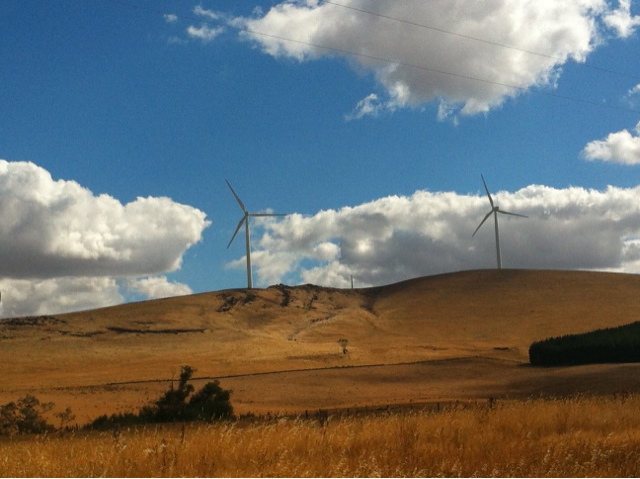
Jemimah and I visited the Waubra Wind Farm on Sunday on our way home from church. We pass by almost every weekend, but it is a long time since we had dropped in for a bit of a look. It was a beautiful day, and I'd hoped that I would have some good photos to show you, but the sun was in just the wrong position, and most of the nice photos are the ones without the wind turbines. Typical. Just imagine the following hills covered with 128 windmills, and you'll get the idea, anyhow.


When Waubra was completed back in 2009, it was the largest wind farm in the Southern Hemisphere. (Nowadays it ranks at number three). It is really quite an impressive sight as the turbines come into view - some places you can see them on every horizon. Jemimah and I had a bit of a chat about those who believe that such wind farms have adverse health outcomes for local residents, and we also discussed some of the benefits of such green power. The Waubra Wind Farm produces enough energy for the nearby city of Ballarat. Quite impressive, when you think about it.


We spent a bit of time reading the information boards and educating ourselves, but to be honest, the thing that had my amateur geologist most excited was the discovery of the square crystals of iron pyrites (fool's gold) in the slate slabs covering the ground outside the Visitors' Centre.


Just like with children's toys, where the carton is often more exciting than the contents, so it was here, where the rubble on the ground was more exciting than the display. We gathered a few bits to show Daddy at home, and then we were back on the road. Amongst landscape like this. Beautiful, isn't it?


While on the subject of electricity, our local supplier had a scheduled shutdown on the weekend for five hours. Despite having UPSs on our computers, whatever they did has totally disrupted our Internet access. Hence the lack of posting from me this week. I'm posting this from my iPad. Lets see what it looks like on the screen, eh? Thanks for your patience.