Showing posts with label AO1. Show all posts

26 May 2016

Substituting Aussie books in AO1


I thought that today we might have a chat about substituting books. The post is for Grace, who asked for it, and for Melissa, Tara, Becci , Agnes, Belinda, Kathleen and LouLou, who got excited about the idea. Grab that coffee, girls, and let's talk books.

Okay, firstly, I've spoken about substituting books before. That post is here, but Ambleside Online is written for Americans living in America, not Aussies living in Australia, and part of the curriculum just isn't relevant for those of us living over here. A certain amount of substitution has to take place, and this is what I want to chat about.

Set?

I'm going to start today by looking at AO1, since that's what you most wanted to hear about. If you like, we can continue on to other years after that. So let's take a look at the AO1 booklist as written. You'll find it here, but you might want to print out a copy to scribble on. Go ahead, I'll wait.


Okay, so you'll see that AO1 covers the years 55 BC to 1066 AD - a huge time period, basically overviewing the time from the invasion of Britain by Julius Caesar up until the...er...invasion of Britain by William the Conqueror at the Battle of Hastings. Now, the history of Britain is really the history of Australia as well, so you're not going to mess much with the books under history, are you? Here they are cut and pasted:

Trial and Triumph, by Richard Hannula ($ K) [2] [3]An Island Story, by H.E. Marshall β Δ ($ K) Ω [4] (Kings and Queens Timeline Figures)* ** Fifty Famous Stories Retold, by James Baldwin, selected chapters β Δ ($ K) Ω Ω Κ [5]** *** Viking Tales, by Jennie Hall , ch 1-11β Δ ($) Ω [6]

Viking Tales is there mainly because the first discoverers of America were the Vikings. You could leave it out for this reason, or substitute, but I didn't. It's a really interesting book. Trial and Triumph is church history. You'll want to read this, unless you're Catholic, then you'll want to read this first and decide.

Next up is a group of books entitled American History Biography. Here are the books:

* Benjamin Franklin, by Ingri D'Aulaire ($)** George Washington, by Ingri D'Aulaire ($)*** Buffalo Bill, by Ingri D'Aulaire ($)

At first glance, people are inclined to leave these out of an Aussie AO, but I'd encourage you not to. Firstly, the D'Aulaire books are delightful, and are beautifully written. You might want to read them just for that. Secondly, Benjamin Franklin and George Washington were really great men. They also happen to be American, but really, they're men important to world history, not just to America. You are going to want your kids to know about Ben and George sometime. Now, here's the rub. If you continue following my Australianised version of AO, you're going to discover that I leave out pretty much all American History, so if you want your kids to know these men, this is your chance. These books give your kids a delightful introduction to two men that they're going to need to know about. Leave them in. I leave in Buffalo Bill and Pocahontas, a free read by the same authors, too, because it is good for your kids to know these stories. You could substitute, if you want, but you'll struggle to find books as good as these, and most Aussie heroes you'll want to save for later years. Leaving the books out completely is an option. Do that if you want, but I wouldn't.


Next up is geography, where the scheduled book is Paddle to the Sea, by Holling C. Holling. You could substitute this for Alison Lester's Are We There Yet? if you want. It's a fabulous book, and a great intro to Aussie geography. The only problem you'll have with this book is that it's much shorter than Paddle, so you'll want to use it over maybe a term, not a whole year. You could do it in addition to Paddle, if you choose. That would be extra good. I didn't do that, but in hindsight, perhaps I should have done. I used it in AO0 instead. I chose to use Paddle to the Sea because it is beautiful, and I'd always wanted to know the Great Lakes myself, and this book teaches them to you. Paddle covers America, Canada, and even across the Atlantic to France, and it teaches it all so delightfully that I can't imagine leaving this book out. You can if you want, but don't tell me if you do. The two books used for physical geography, Charlotte Mason's Elementary Geography, and Home Geography by Long are relevant for Australia, so you'll want to include both of those.

Are you still with me? Let's march onward to Natural History/Science.:

The Handbook of Nature Study, by Anna Botsford Comstock Δ ($), as scheduled in Nature Study; online.James Herriot's Treasury for Children, by James Herriot ($) [8]The Burgess Bird Book for Children, by Thornton Burgess β Δ ($) Ω Κ [9]

I have Comstock, and I use it all the time. This handbook is a cheat-sheet for mum. It's designed to make you look clevah in from of your clevah kids. The idea is this: You find that aphids have taken over the new spring buds on your roses, right? You're irritated by that and try to squash them all, but your kidlets are fascinated, and want to know all about them. You know nothing about aphids except that they suck all the loveliness out of your roses, so you sneak inside (pretend to be going in to collect an icecream container or something), and grab out your book. There on page 351 you'll find a nice big juicy section (heh) on aphids. Speed-read the section, grab up the container and rush back outside. You are now super clevah, and your kids are super impressed Win! There's even an experiment listed for the aphid. Sacrifice a bit of your rose, and bring it inside. You'll learn all sorts of stuff that turns nature study into science. All this comes from Comstock. You want it; you need it. There are lots of things we don't have in Oz that you'll find in the book, but there is plenty enough to make it a useful addition to your homeschool library.

I also list Nuri Mass's The Wonderland of Nature in my curriculum list for AO1, but in hindsight, this book would be better in AO3 or 4. Leave it to then.

James Herriot's book is super lovely. Read it, adore it. Don't forget to read the Christmas story at Christmas time. That's why it's not scheduled, so you can put it where it needs to go.

Which brings us to Burgess. If you look at the footnote for The Burgess Bird Book (You do all read the footnotes, don't you? You absolutely have to), you'll see that you're to do 6 birds per term based on the season and birds that frequent your geographical area. For those of us in Australia, there are almost no birds in this book that frequent our area, so it will be useless for us. What the footnote is telling us, though, is that we are to read about 18 birds that we should be able to find and see. The idea here is to start learning about the birds we know and love. We have no equivalent book to Burgess in Australia. This book is a possibility, but even though it was only published recently, it is not currently in print and is hard to find. I used a delightful book by C K Thompson, Old Bob's Birds, but all of you gals who have followed after me have bought up all the copies, so it's really expensive, and not worth inflated prices, in my opinion. Sometimes you can get hold of his other titles - snap them up if you see them, but I wouldn't pay more than $10.00. Failing that, Leslie Rees's books are good. You're looking for the ones starting The Story of... Again, don't pay more than ten or twelve dollars. Lyla Stevens wrote a beautiful book, Birds of Australia in Colour, which is still available on Abe. Today, at least! I'm inclined to think I would use this book as a spine, reading a bird a week, but read one of Thompson or Rees's books per term to do an in depth study of three over the year. Again let me remind you to study birds you see. Put a birdbath outside your kitchen window, too, and get to know your feathered neighbours! If you really can't find a book, just study your own birds using a field guide. That will do.

Moving right along to poetry

* A Child's Garden of Verses β by Robert Louis Stevenson; ($) Ω Κ [10]** Now We Are Six ($ K) and When We Were Very Young ($ K) by A.A. Milne (4-Volume Pooh Library: $)*** A Child's Book of Poems, by Gyo Fujikawa ($), OR The Oxford Book of Children's Verse, by Iona and Peter Opie ($), OR AO's free online collection of 200 Classic Children's Poems. (K)

You can use the recommendations at listed if you choose, but if you haven't already introduced your child to C K Dennis's A Book for Kids, you'll want to do that this year. I would substitute it for the third term anthologies. You really need to use this book while your kids are young.

I left all the literature and free reading titles as is, and added Australian titles to them. Generally my rule is one book in; one book out so as not to overburden my student, but in AO1, the amount of reading is light enough that a couple of extra books can be added without a problem. In fact, somewhere it says that the book load is deliberately light to allow parents to add their own favourites, but I can't find that right now. Anyhow, to literature - that is scheduled books that required narration after each reading - I added Dot and the Kangaroo by Ethel Pedley, and The Way of the Whirlwind by Mary Durack. I also added Snugglepot and Cuddlepie by May Gibbs and Blinky Bill by Dorothy Wall to the Free Reading list. I did not require narration of these two.

And that, I think might be that. I do hope that's what you are after, ladies, and I'm sure your coffee is cold by now. Have I left you with more questions than answers? Let me know what else I need to address.

Here's pne mpre photo of my beautiful girl. Wasn't she cute?


10 Nov 2014

Amy Mack's nature books

The book of Genesis places man at the head of creation, but makes it clear that he is dependent on nature for his continued existence. In spite of the technology which makes possible synthetic food, clothing and shelter, the human species is still, primarily, a hunter and gatherer of food. Plants must be identified and processed, animals tamed and brought into subjection for the welfare of society. Small wonder that the educators of the nineteenth century emphasised the need for a knowledge of natural science, and that Rousseau's Emile was to be a child of nature. Knowledge was thought to bring mastery.
H. M Saxby, A History of Australian Children's Literature p184

We Aussies have long been proud of our native land. We delight in our strangely fascinating animals and our uniquely beautiful flora, and right from the very first Australian children's book, A Mother's Offering, written in 1841 by Lady Gordon Bremer, natural history has featured largely in our literature. Initially, children's books were meant to instruct, and A Mother's Offering is pointedly educational, moralistic and judgemental, and, to be honest, fairly boring as well for the most part, but it was not long before our new settlers came to love their new land and to delight in passing their love on to others.

It is easy to see that Amy Eleanor Mack (Mrs Launcelot Harrison) loved the bush. Her writing, both for children and adults, was intended to arouse interest in nature, and is is because of that great love that her books can counted amongst the great Australian living books, even when they are used to teach us to be good...which they generally do!

Bushland Stories, Mack's first book written for children, uses fictional stories to explain the facts of natural history to encourage a love of nature and life. The wind, waves, trees, and of course the animals and birds, are all anthropomorphised. They speak and have emotions, and have much in common with the characters in Gatty's Parables of Nature, of which this volume very much reminds me. The things of nature are used to explain the happenings of natural history to her young readers, as well as to teach character traits such as contentment, kindness and satisfaction with what we have. Because Mack was interested, primarily, in conveying botanical and zoological knowledge, however, the plants and animals still behave like their real counterparts enough that we can learn a great deal from them. In The Cocktail's Party, Bluetip the Blue Wren learns with astonishment that as he has grown his plain brown coat has turned to brightest shining black trimmed with gleaming blue.

"But I don't understand," he said. "I thought I was plain brown, like you, but there I am just like father.""When you were a little boy you were plain brown," explained his mother, "for brown is the safest colour for children and mothers. It is not easily seen and so our enemies do not notice the children who are weak, or the mother when she is sitting on her nest. But now you are a strong bird, Bluetip, and able to take care of yourself, so you need not wear your dingy brown coat any longer, and have got this nice blue suit.""Oh, I am so glad," cried Bluetip. "I have always wanted to have a coat like my father's. I am so happy," and he broke into a joyful song.

Man is the enemy, but not frustratingly so, and he can be kind too. Kids are like that, aren't they? Kind one day; cruel the next. Perhaps we all are.

There are 25 stories in the original 1910 edition, although later editions seem to contain between 15 and 18. Keep an eye out for a full version. I read Bushland Stories to Jemimah as a read aloud, somewhere about AO2 or AO3, but I don't seem to have listed it in our curriculum choices, for some reason. I think it is more worthwhile than that, and would certainly recommend that you include it somewhere between AO1-AO3. You can read a story from the book online at Homeschooling Downunder, here.

Bushland Stories was the first volume in Mack's nature series for young children, followed by Waterside Stories and Birdland Stories, all published in 1910. Be careful of overkill with these stories, but they're worth looking out for if you love the first book. Scribbling Sue, illustrated by May Gibbs, was also a book of stories about how nature can teach us to be good. It's probably a bit too moralistic for my taste.

Probably the best known of Mack's books in Aussie homeschooling circles is A Bush Calendar (1909), despite the fact that it is an adult book, and was actually a compilation of articles written for the women's page of the Sydney Morning Herald. It is written as a first person monthly diary of Amy's own wanders in the bush around Sydney, and is illustrated with black and white photographs. It is just delightful - a peaceful type of book - the sort that inspires you to get out into nature to experience it all for yourself.

November 1
It was two butterflies that did the mischief to-day. I had quite made up my mind to have a nice day's sewing, and had planned two blouses to be made; but while I sat at breakfast on the verandah those blue butterflies came floating by, and the blouses were forgotten. In and out amongst the red tips of the gum saplings they flittered, living turquoise in a frame of burnished copper. A little wind, too young to be rough, flittered softly after them and set the red leaves dancing as it passed. Some sunbeams, seeing the dancing leaves, came to join in the fun, and butterflies, leaves, and sunbeams danced and sparkled together in the soft sweet breeze.
It was irresistible. I set down my coffee cup and stood up. "It's no use," I said to myself, " no one could be expected to sit still and sew to-day when all the world's a-dancing. It's a day for the bush!" So off to the bush I went.

Jemimah read this beautiful book in AO7, coinciding each monthly chapter with the correct month of the year. The book begins on August 1, but it lost little by being read January to December, and the benefits of reading the correct months were evident. Each chapter ends with a detailed list of flowers in bloom and birds to be found in and around the coastal areas of Sydney, and Jemimah found it interesting comparing these lists to happenings in our own region.

A Bush Calendar has been reprinted by the lovely Michelle from Homeschooling Downunder. Thanks, wonderful lady, for all that you do for us. It is also at Archive.

A Bush Calendar was followed quickly afterwards by Bush Days in 1911. Written in a similar style, Bush Days is a series of undated stories, quite as delightful as those in A Bush Calendar. My favourite story in this volume is about one of my favourite birds, the Silvereye. It's the story of a young lad who learns to his amazement that the 'sivie' sings as sweetly as a canary:

"I had no idea that silvereyes could sing at all," said one of the men, still gazing up into the branches.I laughed. "It's a case of the prophet in his own country.""Evidently," agreed the man. "I must listen to them in future. It's a good thing to know that we have birds that can sing.""It is," I assented, "the pity is that more people don't know it."Then we all went on our ways, leaving the small singer alone. And he, regardless of his audience, and heedless of their ignorance, still sat amongst the glossy leaves, pouring forth his song of joy and thanksgiving unto the world beautiful.

Until I read this chapter, I didn't know that Silvereyes could sing either.

Jemimah read Bush Days in AO7 as well. On the first week of each month she would read the entry from A Bush Calendar; on the other weeks she read from Bush Days. Bush Days is available from Archive.

Amy Mack also wrote another book for adults, The Wilderness, in 1922. I haven't used this with Jemimah yet, but plan to in a couple of years. I'll keep you appraised!


26 Mar 2014

Traditional counting songs

In the early years, the MEP lesson plans call for 'counting songs'.  These interludes are there to prevent brain strain - remember that MEP in a classroom takes 45 minutes, and that's a long time for a small person.  But a well chosen song can have value for another reason too - to practice counting backwards and forwards.  Counting backwards is harder than you think.  If you consider yourself mildly proficient in a second language, try counting backwards from numbers other than ten.  It is pretty hard!  That's what it is like for our youngsters as well.

Here are some of our favourite counting songs.  There are lots of modern ones as well, but this is most of the traditional ones.  Hopefully you'll find something that you and your kiddos like!

For obvious reasons, the ones counting forward and backward are probably best.  Have fun!

(Also, singing counting songs in your foreign language is also great practice...even in the middle of maths!  That's probably another post.)


Once I Caught a Fish Alive

1, 2, 3, 4, 5,
Once I caught a fish alive,
6, 7, 8, 9, 10,
Then I let it go again.
Why did you let it go?
Because it bit my finger so,
Which finger did it bite?
This little finger on the right.


Ten Green Bottles

Ten green bottles
Hanging on the wall
Ten green bottles
Hanging on the wall
And if one green bottle
Should accidentally fall
There'll be nine green bottles
Hanging on the wall

Nine green bottles
Hanging on the wall...and so on.

Finish with:

One green bottle
Hanging on the wall
One green bottle
Hanging on the wall
If that one green bottle
Should accidentally fall
There'll be no green bottles
Hanging on the wall.


There were 10 in the Bed

There were ten in a bed
And the little one said
'Roll over, roll over'
So they all rolled over
And one fell out

There were nine in a bed
And the little one said...etc

Finish with:

There was one in a bed
And the little one said
'Good night!'

There are many variations to this song. We love the one with the following sung between the verses, so if you have just sung the 'There were seven in bed' verse it would be:

Bumped his head,
And gave a shout.
Please remember,
To tie a knot in your pyjamas,
Single beds are only made for (then shouted) Ten, Nine, Eight, Seven, six in the bed and...

(Anyone know a YouTube video for this variation?)


10 Little Indian Boys

1 Little, 2 Little, 3 Little Indians,
4 Little, 5 Little, 6 Little Indians,
7 Little, 8 L9ittle, 9 Little Indians,
10 Little Indian Boys!

Then count down again!


One, Two, Buckle my Shoe

One, two, buckle my shoe,
Three, four, open the door,
Five, six, pick up sticks,
Seven, eight, lay them straight
Nine, ten, the big fat hen,
Eleven, twelve, dig and delve,
Thirteen, fourteen, maids a-courting,
Fifteen, sixteen, maids in the kitchen,
Seventeen, eighteen, ladies waiting,
Nineteen, twenty, my plate's empty.


This Old Man

This old man, he played one,
He played knick-knack on my thumb;
With a knick-knack paddywhack,
Give a dog a bone,
This old man came rolling home.

This old man, he played two,
He played knick-knack on my shoe;
With a knick-knack paddywhack,
Give a dog a bone,
This old man came rolling home.

This old man, he played three,
He played knick-knack on my knee...etc.

This old man, he played four,
He played knick-knack on my door...etc.

This old man, he played five,
He played knick-knack on my hive...etc.

This old man, he played six,
He played knick-knack on my sticks...etc.

This old man, he played seven,
He played knick-knack up in Heaven...etc.

This old man, he played eight,
He played knick-knack on my gate...etc.

This old man, he played nine,
He played knick-knack on my spine...etc.

This old man, he played ten,
He played knick-knack once again...etc.


Ten Little Ducks

Ten little ducks went out one day,
Over the hills and far away.
Mother duck said
'Quack, quack, quack,'
But only nine little ducks came back.

Continues with:

Nine little ducks went out one day,
Over the hills and far away...etc.

Finish:

No little ducks went out one day,
Over the hills and far away
Mother duck said
'Quack, quack, quack,'
And all those ten little ducks came back.


One Bottle of Pop


This is a great song!!

One bottle of pop, two bottles of pop,
Three bottles of pop, four bottles of pop,
Five bottles of pop, six bottles of pop,
Seven, seven, bottles of pop, pop!

Fish and chips and vinegar, vinegar, vinegar
Fish and chips and vinegar,
Pepper, pepper, pepper, salt!

Don't throw your trash in my backyard,
My backyard, my backyard.
Don't throw your trash in my backyard,
My backyard's full!


Five Speckled Frogs

Five little speckled frogs
Sat on a great big log
Eating some moist delicious flies (Yum, yum, yum!)
One jumped into the pool
Where it was nice and cool
Now there are four speckled frogs! (Ribbit, ribbit!)


Five Little Monkeys

Five little monkeys jumping on the bed,
One fell off and bumped his head.
Mama called the Doctor and the Doctor said,
"No more monkeys jumping on the bed!'.

Four little monkeys jumping on the bed,
One fell off and bumped her head...

Finish:

One little monkey jumping on the bed,
He fell off and bumped his head.
Mama called the Doctor and the Doctor said,
"Put those monkeys straight to bed!'.


One Man Went to Mow

One man went to mow, went to mow a meadow,
One man and his dog - Woof! - went to mow a meadow.

Two men went to mow, went to mow a meadow,
Two men, one man and his dog - Woof! - went to mow a meadow.

Three men went to mow, went to mow a meadow,
Three men, two men, one man and his dog - Woof! - went to mow a meadow.

Four men went to mow, went to mow a meadow,
Four men, three men, two men, one man and his dog - Woof! - went to mow a meadow.

Five men went to mow, went to mow a meadow,
Five men, four men, three men, two men, one man and his dog - Woof! - went to mow a meadow.

You can count as high as you like!

Enjoy!  Have I included your favourite counting song?  If not. leave me a link in the comments.  I'd love to listen.

PS There are as many variations to the lyrics of these songs as there are songs.  The lyrics here are my family's personal favourites.  They're the right ones, of course. Heh.

Here's a playlist for all these songs if you like them like that.

17 Jan 2013

May Gibbs Google Doodle


Hey, are you all enjoying today's Google Doodle as much as I am? Happy 136th Birthday, May.

Here's a list of her works:

About Us (1912)
Gumnut Babies (1916)
Gumblossom Babies (1916)
Boronia Babies (1917)
Flannel Flowers and Other Bush Babies (1917)
Wattle Babies (1918)
Tales of Snugglepot and Cuddlepie (1918)
Little Ragged Blossom (1920)
Little Obelia (1921)
Nuttybub and Nittersing (1923)
Chucklebud and Wunkydoo (1924)
Bib and Bub: Their Adventures (1925)
The Further Adventures of Bib and Bub (1927)
More Funny Stories about Old Friends Bib and Bub (1928)
Bib and Bub in Gumnut Town aka Two Little Gum-Nuts (1929)
The Complete Adventures of Snugglepot and Cuddlepie (1940)
Scotty in Gumnut Land (1941)
Mr and Mrs Bear and Friends (1943)
Prince Dande Lion (1953)
Do you all like Snugglepot and Cuddlepie the best? Our very favourite Gumnut Baby story is The Story of Chucklebud and Wunkydoo. If you read it aloud you'll know why - it is just plain good Aussie fun. Here's an extract:
Now, these little Nuts were the most inquisitive little Nuts that ever sat in a gumtree. All day long they went about saying 'Why?' and 'How?' and 'When?' and 'What for?' till their parents grew quite tired of answering them and even the Bush Creatures would hide when they saw them coming, or pretend to be deaf.

One day Chucklebud said to Wunkydoo, 'Oh, I do wish I knew a lot of things.' 'So do I,' said Wunkydoo. 'Everybody knows something,' said Chucklebud. 'But nobody knows everything.' said Wunkydoo.

As they talked, a breeze swayed a leaf on which they were sitting, and away down in the valley they heard the voice of Mr Wackasmack, the Kookaburra.

It was a loud voice, and they heard quite plainly what he said.

This is what they heard:

'There's some thinks they know a lot, and a lot as knows they thinks some, but nobody knows what I know because I never tell.'

Chucklebud looked at Wunkydoo and Wunkydoo looked at Chucklebud till their blue eyes grew very round; then they nodded and put their faces close together till their small noses touched.

The breeze swayed the leaf again, and again the voice of Mr Wackasmack wafted up from the Valley. There were no words this time, only a low chuckle.

The blue eyes of Wunkydoo twinkled. 'Shall we go?' he whispered.

'Yes,' whispered Chucklebud.
So good.

We read The Complete Adventures of Snugglepot and Cuddlepie in AO1 and Scottie in Gumnut Land in AO2.

21 Oct 2011

On very long sentences

I want to take you on a rabbit trail through my head. Then this post will make sense. Vaguely.

Ready? Right.

It begins here at Dewey's Treehouse, where Mama Squirrel tells us to go here to read a post on Plutarch written by Cindy of the Dominion Family/Ordo Amoris, on the classical Circe Institute blog.

She tells us to read the comments while we're there, so I do. I am very compliant. In the comments Mama Squirrel tells us to toddle off here to read about how even Frankenstein's monster read Plutarch. (Whodathunkit?)

Are you keeping up?

Once here, Mama Squirrel points out that if he learns nothing else from Plutarch, the monster at least learns to write very long sentences. Certainly, he will have learned to read them, because Plutarch is characterised by his closely packed, extremely long sentences.

Apparently the post was written in response to this one, "Celebrating the Long Sentence: Winnie-the-Pooh and the Slow Language Movement" at The Wine-Dark Sea. So off I go. Click.

Here Melanie tells us that one of her very favourite long sentences of all time is this one. It's from Chapter IX of Winnie the Pooh, "In Which Piglet Is Entirely Surrounded by Water":
In after-years he liked to think that he had been in Very Great Danger during the Terrible Flood, but the only danger he had really been in was in the last half-hour of his imprisonment, when Owl, who had just flown up, sat on a branch of his tree to comfort him, and told him a very long story about an aunt who had once laid a seagull's egg by mistake, and the story went on and on, rather like this sentence, until Piglet who was listening out of his window without much hope, went to sleep quietly and naturally, slipping slowly out of the window towards the water until he was only hanging on by his toes, at which moment luckily, a sudden loud squawk from Owl, which was really part of the story, being what his aunt said, woke the Piglet up and just gave him time to jerk himself back into safety and say, "How interesting, and did she?" when-- well, you can imagine his joy when at last he saw the good ship, The Brain of Pooh (Captain, C. Robin; Ist Mate, P. Bear) coming over the sea to rescue him.
This is certainly a very long sentence. It is not, however my favourite very long sentence.

All of this introduction is because I now want to share with you my very favouritest very long sentence.

Are you ready? Okay, here goes:
Then the brutal minions of the law fell upon the hapless Toad; loaded him with chains, and dragged him from the Court House, shrieking, praying, protesting; across the market-place, where the playful populace, always as severe upon detected crime as they are sympathetic and helpful when one is merely "wanted," assailed him with jeers, carrots, and popular catch-words; past hooting school children, their innocent faces lit up with the pleasure they ever derive from the sight of a gentleman in difficulties; across the hollow-sounding drawbridge, below the spiky portcullis, under the frowning archway of the grim old castle, whose ancient towers soared high overhead; past guardrooms full of grinning soldiery off duty, past sentries who coughed in a horrid, sarcastic way, because that is as much as a sentry on his post dare do to show his contempt and abhorrence of crime; up time-worn winding stairs, past men-at-arms in casquet and corselet of steel, darting threatening looks through their vizards; across courtyards, where mastiffs strained at their leash and pawed the air to get at him; past ancient warders, their halberds leant against the wall, dozing over a pasty and a flagon of brown ale; on and on, past the rack-chamber and the thumbscrew-room, past the turning that led to the private scaffold, till they reached the door of the grimmest dungeon that lay in the heart of the innermost keep.
Impressive eh? Read it aloud. Then you'll discover how long it really is. Better still read them both aloud. I just did.

It comes from Kenneth Graham's Wind in the Willows. The reason I love this very, very long sentence, is that it comes in the book just after Toad has received his own very, very long sentence - a year for the theft of a motor car, three years for "furious driving" and fifteen years for cheeking a police officer rounded up a year to make it an even 20 years to "be on the safe side".

This strikes me as being incredibly subtly cool on Mr Graham's part, and I wanted to share it with you here.

Which I have.

The rabbit trail is why. I hope you enjoyed following it as much as I did.

Don't you think word play of this type is pure delight? I just love stuff like this.

31 Mar 2010

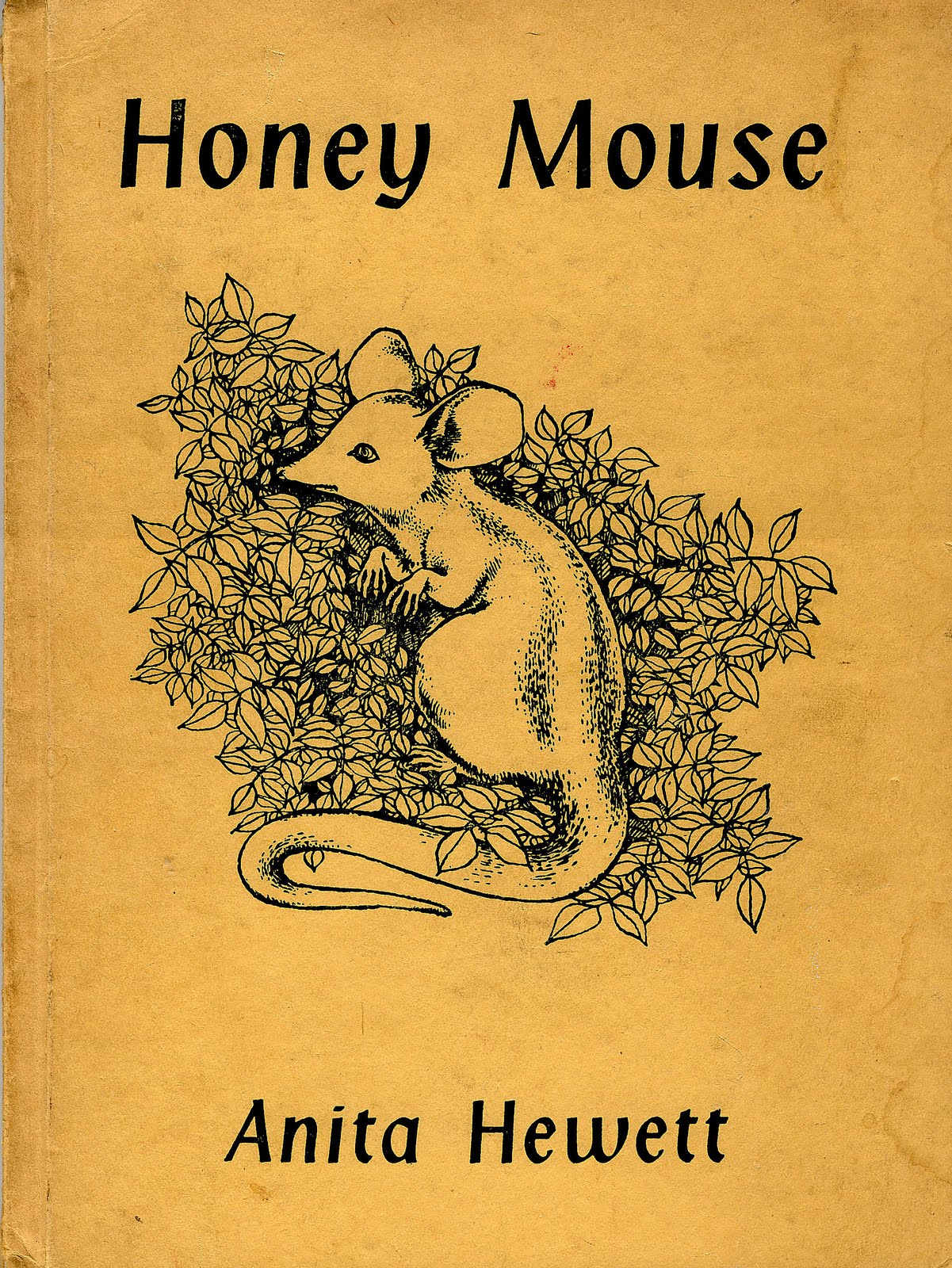
Honey Mouse

It seems the reviewers don't quite agree over Honey Mouse. In A History of Australian Children's Literature (1971), the doyen of Aussie lit commentators, Maurice Saxby wrote:
Originally written for English children this is a pleasant production with sepia drawings by Margery Gill, useful for story hours, and of interest also to the younger reader because of its brief texts.
The writers of The Oxford Companion to Australian Children's Literature(1993), Stella Lees and Pam Macintyre, on the other hand rather denigrate the book. Read what they have to say:
Not all animal stories represent animal life so well. Inaccuracies abound... This poor example of the depiction of Australian animals perpetrates such inaccuracies as 'koala bears'. In Anita Hewett's Honey Mouse and Other stories (1957), which contains ten stories about Australian birds and animals, the animals are humanised, dressed, and the settings inaccurate. Koalas are again referred to as bears, and in the same natural environment the reader finds koalas, cassowaries, turtles, bats, dingoes and pythons.
Goodness, girls! Is it really that bad? Come on - it was written back in 1957. By an English woman. When I was growing up a decade later we called them koala bears as well. Everyone did back in the 'olden days'. Overseas they still do.

Honey Mouse is not a natural history book. It is a pleasant little animal fantasy useful for story hours and for newly fluent readers to read alone. Just like Mr Saxby said. While they're reading our kids will pick up lots of incidental knowledge about our Australian birds and animals. They'll be reminded that brolgas dance; that male cassowaries look after their eggs in nests on the ground, while the brush turkey hides hers in a big mound, and the platypus in a platypussary; that lyre birds are mimics; that jabiru stork eats fish; and that kookaburras laugh at misfortune. As if an Aussie kid didn't already know that bit:
"Kookaburra laughs," they said. "He laughs when he's happy and he laughs when he's sad. We hope he will always laugh. We like it."
There are no clothed animals, but they do talk. So what? Similarly, there are inaccuracies in environment. This didn't matter to us, one whit, because I don't think that's what the book's written for. Since we read the book as a read aloud I did substitute 'koala' for the old fashioned inaccurate 'koala bear'. We also discussed the fact that Green Turtles are unlikely to be carrying koalas very far on their backs and in fact spend most of their time in the sea, returning to the beaches only to lay their eggs. Good opportunity for a science lesson thought I, ever the teaching mummy.

Anita Hewett knows what kids like to read about, and she does it very well. They are light little moralistic tales using characters from our Australian bush. We liked it.

I was interested to read here of Hewett's upbringing in a strict Baptist family by a father who was Deacon, organist and Sunday School Superintendent. Anita taught the baby class. Despite later rebelling against her religious upbringing, Christian morals shine brightly throughout the ten little stories contained in Honey Mouse. Kindness, perseverance and consideration contrast with pride, indecision and forgetfulness. Lots of character building material here if you want it.

Fun too - just what the kids want. And they, after all, are the intended audience of Honey Mouse - not erudite reviewers in ivory towers.

Lizard Comes Down from the North is your classic Chinese Whispers tale. In it, little green lizard decides to make a long, long journey...
..."Over bushland and sand and grassland and scrub." And he hopped in the air with a squeak of delight because he felt gay and brave and adventurous.

Then Lizard looked up against the sun, and far above him the black-feathered swan beat his wings in the air, and called: "Why are you coming down from the north, you strange little thing with a scaly back?"
Doesn't sound too scary here, does he? Wait until later in the story though, where Lizard meets his alter ego:

"It's a long, long journey I've made," he said. "Over bushland and sand and grassland and scrub."

He hopped in the air with a squeak of delight, because he felt happy and safe and friendly."

Then Lizard looked up...and...he saw the wall, and over the top of it, the faces of Bower Bird, Possum, Platypus, Turkey, and Wombat.

"And what are you doing, up there?" he asked.

The five faces stared at the little green lizard.

"We're hiding from the dragon," said Bower Bird.
"He's coming down from the north," said Possum.
"He'll eat us all up if he can," said Platypus.
"He has huge shining scales, and a great lashing tail, and he's crashing along to the forest," said Turkey.
"What a time we've had!" said Wombat.

Lizard's small scales shone green in the sun as he flicked his tiny tail in the air. Then he pattered behind the wall, and said:
"Please may I hide behind your wall? I'm not very fond of dragons myself."

Oh dear.

I suppose you could use this story as an illustration of facing your imaginary foes, but we just laughed and laughed. Just as Lizard does when he realised what has happened:
"Oh my, I'm a dragon, I am!" he said. "Oh ho! I'm a dragon. A great fierce dragon!"
Then Lizard flicked his tiny tale, and he rolled on the ground with his legs in the air, laughing and laughing and laughing.
Shame the reviewers didn't read Honey Mouse the same way - as a delightful little book for young children. You can use it for character development if you choose to. We didn't. You can use it for nature study with some discussion too. We didn't. Jemimah learned from it anyway. She learned from the author herself - not from me getting in the way and telling her what she should know. She certainly doesn't believe that koalas talk, or that wombats tie strings to their tales so they won't forget. She does know that brolgas dance and platypus live in platypussaries though. Did you?

She also knows not to believe everything she's told. Perhaps someone should tell the reviewers that kids are not so naïve as they fear.

25 Mar 2010

Calling Aussie Fairy Lovers


I think I would have liked the artist Ellis Rowan. Born in 1847, she failed to be constrained by the nineteenth century conventions placed upon young gentlewomen of her time.

Like me she had a bad attack of the wanderlust, using the cold winters at the home in Victoria's Mount Macedon, as an (entirely plausible) excuse for gallivanting throughout Australia and New Guinea, and even as far as the United States. Many of the places she visited were remote, and she was often the only, or one of a very few, white women in the area. And wherever she travelled she painted.

Perhaps it is Charlotte Mason's influence upon my current life, but I find myself nodding with approval at stories depicting her scrambling up rocks by clinging to vines as she searched for flowers on Murray Island, North Queensland, leaving her party behind in her wake. She held huge tarantulas in her hand before painting them. Ugh. She had a total fascination with natural objects, and constantly searched for more and more colourful and unusual objects to paint.

In her book A Flower Hunter in Queensland and New Zealand, she recounts the occasion when, while attempting to cross the Bloomfield River, south of Cooktown, she became trapped on a log by a rapidly rising tide. I dare say the crocodile circling her did not bring her much joy. She was finally rescued by Aborigines.

Oh yes, I would have liked Ellis Rowan very much indeed.

The National Library of Australia is home to more than 900 of Ellis Rowan's paintings, and in their new book, Fairy World, they have taken 11 of these and turned them into delightful fairy havens that introduce her floral depictions to a new generation of young Australians.

The YouTube video depicts the book in all its glory. On one side of the page is a description in rhyme about the plant on the other side. These include the Bumpy Satin Ash, the Pitcher Plant, the Red Flowering Gum and Sturt’s Desert Pea. Rowan's original paintings, have been altered to include a flap that can be raised to reveal a pretty fairy or cheeky elf hiding in the foliage. Cute. ‘Did you know’ fact boxes are also included about each of the plants.

I would love to do an artist study about Ellis Rowan for school. I may do just that, in fact, but until that time comes, I think this book is a super way to introduce my 8 year old fairy lover to the delights of this exquisite artist. Not that I think that the fairies add, mind you. Publishers nowadays fail to appreciate that a child could actually be interested in nature, flowers and art for their own sake. They seem to believe that an appreciation for our flora will never be acquired by mere observation, but rather has to be helped along by fairies and other methods designed by adults to awaken the child's otherwise deadened imagination. Yeah.

A child raised on a diet of living books, poetry, art and nature will enjoy this lovely book regardless of whether there are fairies hiding in the pictures or not. For the child that has not, the poetry and nature facts will probably fail to impress even with the distraction of the wee folk.

For me Ellis Rowan's pictures are enough. I will be purchasing this book for Jemimah as soon as the budget allows. I will also look for a copy of A Flower Hunter for me to read. In the mean time, I'll be getting my fix here in the Ellis Rowan pages of the National Library of Australia. Over 400 of her paintings have been digitised, and can be viewed on the Library’s Pictures Catalogue by entering the search term ‘Ellis Rowan’.

I can't believe I've not heard of her before. Have you?

17 Mar 2010

The Story of Blinky Bill

I reckon there's probably a story about the reprinting of this delightful book about Blinky Bill. It just popped up on the bookshop shelves in December - a little facsimile edition paperback amongst all the glossy Christmas offerings. It wasn't even put on display in the shop where I purchased it, but my super keen Australian literature eyes spotted it immediately.

A Tiny Story of Blinky Bill is a new-to-me offering from the incomparable Mrs D. Badgery, otherwise known as Dorothy Wall about the much loved larrikin koala, Blinky Bill. Blinky is as Australian as Snugglepot and Cuddlepie or The Magic Pudding, and like these two retains its status as an Australian Children's Classic.

Children can relate to Blinky. He is dreadfully naughty, but her doesn't really mean to be. He is curious and loves to explore - ideally while Mrs Bear and Nutsy are asleep - which they are often. Blinky always gets into mischief, whether he wants to our not. Sometimes it's not even his fault!

Sound like someone you know?

In the tiny story, Blinky has a grand idea. So exciting!

He creeps out of bed in the middle of a beautiful moonlight night, meets up with his friends, Splodge the Kangaroo and Wally the Wombat, who are gossiping at the edge of the stream that flows merrily through Farmer Brown's property, and enlists them in a plan to try a bit of midnight fishing.
"Fish!" Splodge and Wally both exclaimed with surprise. "And where do you think you'll get fish in this part of the world? Why I've never heard of such a thing!" cried Splodge with a scornful look.

"I'll get them in there, silly," Blinky snapped angrily, pointing to the stream. "Why it's full of fish! Millions of them!"

"Rubbish!" Wally exclaimed, "and anyhow you can't just catch fish by sitting on the bank and wishing for them."

"I'm going to borrow Farmer Brown's boat," Blinky replied boldly. Farmer Brown isn't using it, and it's going all rusty just lying about and doing nothing."
Ah yes, famous last words.

What adventures do Blinky and his friends get up to next? And what does Mrs Koala say when she finds out? Which she will, because mothers always know such things. You'll need to read the book to find out, won't you?

A Tiny Story of Blinky Bill is written in a simpler style than the other Blinky Bill offerings - I'd estimate it to have a Lexile measure of around about 800 or so. The type is large enough that it will be easily read by many emerging readers. Jemimah read it to me.

First published in 1947, A Tiny Story of Blinky Bill was published posthumously five years after Wall's sudden and unexpected death in 1942 from pneumonia. One wonders when it was first written. The illustrations, certainly, bear a far greater similarity to her earlier works than to the cartoon-like offerings of Blinky Bill and Nutsy, which was published in 1937.

See, I told you there was a mysterious story out there about this book that I don't know.

We read the Blinky Bill omnibus in AO1. A beautiful new version of this book titled The Complete Adventures of Blinky Bill was published by Harper Collins Australia late last year to coincide with the seventieth anniversary of the first edition in 1939. The glossy new luxury hardback version contains Blinky Bill: The Quaint Little Australian (1933); Blinky Bill Grows Up (1934) and Blinky Bill and Nutsy (1937). As well as Dorothy Wall's original stories, the volume also uses the Wall's original plates, many in glorious colour. In addition it includes a fascinating biography of Dorothy Wall, and early reviews of the first edition. I am so glad I have this book. (Not that I really needed another version of a story I already have in two or three other books, but you know how it is.)

This review from The Southern Districts Advocate, Katanning 27th November 1933 and included in the new book accurately summarises the appeal of Blinky Bill for me:
Children will be entranced by Blinky Bill's experiences and adventures: his christening; his wonderful rides on Angelina Wallaby's back; his encounter with Miss Pimm in a wayside store where he has helped himself to peppermints; his adventures in Frog Hollow; the riot he caused at Bobbin Rabbit's party; and the prodigal's periodical returns to his gum-tree amid the tears and rejoicings of his mother and the caustic comments of Mrs Grunty who lives in the same tree.
Don't let your young Aussie grow up without Blinky Bill, will you?

Finally, an anouncement from our sponsor:
If any little girl or boy should be the proud owner of a koala, please remember the poor wee thing cannot eat sweets, fruit, nuts, or all the nice things you like so much. His digestive organs are very primitive and all he needs is his own food—gum-tips; but remember not every gum-leaf is good for him, only those from the York, Flooded, Manna, and White gum-trees are suitable.

These little animals need a great deal of petting and attention when in captivity, as petting is very necessary for them. They fret and grieve and finally die, if they are left alone, just as a baby would. The kindest action of all would be to leave the koala baby in his own bushland, among his own playmates, with the sun, the sky, the birds, and the gum-trees, where he will grow to manhood and live for many years—happy as he should be.

Dorothy Wall Blinky Bill and Nutsy 1937

2 Feb 2010

The Groundhog's Shadow

So today is Groundhog Day.

Well, it is in America. Here it's the second of February. No more. no less. Except for one thing. You know how in the movie of the same name Phil the egocentric Pittsburgh TV weatherman finds himself repeating the same day over and over again while covering the Groundhog Day event in Punxsutawney? Well here on the 2nd February we find ourselves repeating something over and over as well. And do you know? It involves groundhogs!

Every year on Groundhog Day we read a special book. It's called The Groundhog and his Shadow and it is by Kurt Wiese. He's the guy who illustrated Ping and The Five Chinese Brothers and...well and lots of things. 300 other things in fact. He drew lots. And he wrote this too. In between illustrating. Maybe when he should have been sleeping. Don't know. Anyhow, he did it sometime. We like it too.

Father Groundhog dutifully arose on February 2 so that the people who were waiting for him wouldn't be disappointed, but it was a tiresome proceeding and when he saw his blue shadow stretching long over the sparkling snow he turned on his heel and went back to bed for another six weeks. Because that's what groundhogs do if they see their shadows, you know.

"I wish I could get rid of that shadow!" he muttered grimly into his frozen moustache (well it is spelled mustache because it is American, only that looked too funny so I had to change it.) At any rate, it didn't take much to persuade him to sell his shadow to a fox for a bundle of hay.

The fox tried to sell the shadow to the weatherman,but he refused to buy it:
"Such nonsense! Nobody really believes that old fairy tale, least of all a scientist like me, who has all his instruments working for him with great accuracy. Now get out of here before I call the dog-catcher."
So the fox ran off, leaving the shadow alone to make its own way back to its partner who so greedily had sold him for a handful of hay. But when Father Groundhog sees the blue thing coming toward him with outstretched arms he is frightened and runs away was fast as he can to get away. And the thing comes nearer and nearer...

It is cute and it is fun. It's frivolous lightweight fun. And probably twaddle. We've never missed it.It just wouldn't be Groundhog Day without it.

Happy Groundhog Day to all my American friends. Have you been outside to see whether you have a shadow yet today? Why don't you pop over to the official Website of the Punxsuatwney Groundhog Club and see what they've got planned? Perhaps you could join them.

Don't you just love the way that word looks in print...Punxsuatwney. Wow.
Old Groundhog stretched in his leafy bed.
He turned over slowly and then he said,
"I wonder if spring is on the way,
I'll go and check the weather today.
If I see my shadow between eleven and noon,
I then will know that I'm out too soon.
I'll crawl back in bed for six weeks more,
Pull up the warm covers and snore and snore.
But if no shadow gives me a scare,
I know that spring is in the air,
I'll wake my friends and wish them cheer,
With glorious news that spring is here."

29 Jan 2010

The Lion and the Mouse

Jerry Pinkney talks about his new wordless picture book, The Lion and the Mouse, an adaptation of Aesop's fable of the same name. Pinkney is the 2010 recipient of the Randolph Caldecott Medal awarded annually to the artist of the most distinguished American picture book for children.


I'll be toddling into Readings for my copy of this one when next I'm in Melbourne. I know Jemimah is probably a bit old, but her mummy's not!!

Sigh, I wonder how long I can justify buying picture books for. They're just so beautiful, aren't they?!!

Have a good weekend, guys. We'll be hanging out at home. Pool, deck, garden, bbq, good books, good food, good coffee. You get the idea. What about you?

25 Jun 2009

Iconically Australian

The Art Gallery by May Gibbs from Snugglepot and Cuddlepie 1918

It's impossible, I think, to compile a list of Classic Australian Children's Literature without including May Gibbs' The Tales of Snugglepot and Cuddlepie. Her gumnut babies are iconic - like Vegemite, or the Hill's Hoist, or a Four'N'Twenty pie. They're a unique part of what makes us Australian.

Her expressions have entered our National vocabulary too: "Stone and bone her"; "Rack and crack him"; "String and ring him"; even "Deadibones as a doorknob" - our language would surely be the poorer without them. Certainly our family's speech would.

It is difficult to walk though our Australian bush without finding evidence of the gumnut babies, their hats and their skirts lying discarded under the gum trees, and those big, bad banksia men, eyes open and staring menacingly at everything. You can even see their scribbly writing on the trees!

To me, May Gibbs is Australia's Beatrix Potter. A childhood without either one would be unthinkable.

The Tales of Snugglepot and Cuddlepie is her best known book. It's A story about the eponymously named gumnut babies, Snugglepot and Cuddlepie, on a journey towards Gumnut Town. Their fantastical adventures and strange travelling companions, like the anthropomorphised kookaburra or Mr Lizard, make for exciting reading - a world where good always triumphs over evil - as it should.

May Gibbs wrote lots of books about the Gumnut Babies. Read as many of them as you can.

We read the first three books in the Snugglepot and Cunnlepie series in AO1. The three, entitled: Snugglepot and Cuddlepie; Little Ragged Blossom; and Little Obelia are available in one volume called The Complete Adventures of Snugglepot and Cuddlepie by Angus and Robertson. It's a beautiful book. We read another of the series, Scotty in Gumnut Land in AO2. It doesn't matter which ones you choose; they're all good.

Although not so well known as Snugglepot and Cuddlepie, our very favourite Gumnut Baby story is The Story of Chucklebud and Wunkydoo. If you read it aloud you'll know why - it just sounds good, that's why! Here's a teaser...
Now, these little Nuts were the most inquisitive little Nuts that ever sat in a gumtree. All day long they went about saying 'Why?' and 'How?' and 'When?' and 'What for?' till their parents grew quite tired of answering them and even the Bush Creatures would hide when they saw them coming, or pretend to be deaf.

One day Chucklebud said to Wunkydoo, 'Oh, I do wish I knew a lot of things.' 'So do I,' said Wunkydoo. 'Everybody knows something,' said Chucklebud. 'But nobody knows everything.' said Wunkydoo.

As they talked, a breeze swayed a leaf on which they were sitting, and away down in the valley they heard the voice of Mr Wackasmack, the Kookaburra.

It was a loud voice, and they heard quite plainly what he said.

This is what they heard:

'There's some thinks they know a lot, and a lot as knows they thinks some, but nobody knows what I know because I never tell.'

Chucklebud looked at Wunkydoo and Wunkydoo looked at Chucklebud till their blue eyes grew very round; then they nodded and put their faces close together till their small noses touched.

The breeze swayed the leaf again, and again the voice of Mr Wackasmack wafted up from the Valley. There were no words this time, only a low chuckle.

The blue eyes of Wunkydoo twinkled. 'Shall we go?' he whispered.

'Yes,' whispered Chucklebud.

11 Jun 2009

AO1 Term Two Exams

Here's term 2...

Exam Questions Year 1 Term 2
Bible

1. In your own words, tell as much as you can remember about Jacob.
2. What can you tell me about covenants – can you name two and tell me anything about them?
3. Can you tell me anything about the books that we studied that were written by Paul?

Memory

1. Recite Notre Père to Daddy.
2. Westminster Catechism questions. How many can you get right?
3. Can you recite the books of the New Testament in order?

Writing

1. Write the alphabet in lower case letters in your very best writing.
2., Please write, using your very best writing: The quick brown fox jumps over the lazy dog. Watch punctuation, slope and spacing.

Reading

1. Read for 5 minutes from Frog and Toad Together. (Level 2)
2. Read for 5 minutes from The Outside Dog. (Level 3)

U.S. History

1. What do you know remember about when George Washington was a boy??
2. Why is he called the father of America?

World History

1. Who was Antonio Canova and what did he do that was so remarkable?
2. What can you tell me about why King Arthur made a round table for his knights?
3. Tell of what you can remember of the story Picciola.
4. Illustrate one of the following:

a. Whittington and his Cat,
b. Washington and his Hatchet or
c. Grace Darling.

5. What is a martyr?
6. Tell me about Monica and Augustine, the Christian mother and son; Ambrose, Bishop of Milan or Athanasius against the world.

Geography

1. Using your map, please explain Paddle’s journey so far.
2. Which of the Great Lakes can you name?
3. What is the name of the country to the north and south?
3b Which country does Auntie Meriel live in?
4. Tell me the part of Paddle’s journey that you have liked best so far?
5. What is the capital of France?
6 Do you know any countries where they speak French?

Natural History and General Science

1. Why did Mr Dakin have to sell Old Blossom? Why was he sad to see her go?
2. What is your favourite story from Old Bob’s birds?
3. Tell as much as you can about one of the birds we have learned about.
4. What has been your favourite nature study topic?
4b. Draw a picture of this animal and label it in French and English.
5. Show your nature study book to Daddy and explain it to him.

Literature and Tales

1. Tell the story of “As You Like It” or “The Winter’s Tale”. You may use Little People to help you illustrate the story if you wish.
2. Tell the story, Oh Best Beloved, of how the first letter was written.
3. Please retell one of the fables you have heard this term and what you think it is trying to teach.
4. Can you draw a picture about one of the fairy tales we have read about this term?
5. Can you tell the story of the flowers and the wind in Training and Restraining?

Mathematics

1. Complete review sheet 40.
2. Complete French maths sheet.
3. Explain what the terms “plus que”, “moins que” and “autant que” mean and give a demonstration with counters.
4. Count as high as you can in French in units and tens.
5. Count backwards in English from 100 to 0 in fives.

French

1. Can you tell me the months of the year in French and English?
2. Do you know the seasons in French and English?
3. What about the days of the week?
4. Greet Daddy in French and ask him how he is feeling.

Picture Study

1. What is the name of the artist we studies this term? Where did he live?
2. Describe your favourite picture from this term's picture study.
3. Can you think of any others?

Composer study

1. What is the name of the composer we have been studying this term? What can you tell me about his life?
2. Tell me the real story of “The Heroic Symphony”.

Singing

1. Sing all the songs from this term in front of Daddy.

Handicrafts

1. Show your tapestry to Daddy and explain how you do it.

AO1 Term 1 Examination Questions

Our Northern Hemisphere friends are beginning to chuckle with misplaced glee as the warm weather arrives and along with it the promise of long summer holidays and days lazing in the sun.

Fortunately, she says enviously - and tongue in cheek - the pleasure of some of you will be tempered somewhat by the prospect of examinations looming, and with that comforting thought I offer you some long awaited exam questions for AO1.

Seriously, the prospect of writing Charlotte Masonesque Examinations for our kiddywinks brings some of us out in a cold sweat. These are the questions I used for Jemimah in AO1 Term 1. AO1 Term 2 will follow. I hope they're useful for some.

Enjoy the warm weather for me, will you!

AO1 Term 2
AO1 Term 3
AO2 Term 1


Exam Questions Year 1 Term 1

Bible

1. In your own words, tell about your favourite character that you read in your Bible reading this term.
2. In your own words, tell about your favourite event that you read in your Bible reading this term.

Memory

1. Recite as much of Notre Père as you are able to Daddy.
2. Recite 1 Corinthians 13 to Daddy.
3. Recite The Lord’s Prayer to Daddy.
4. Westminster Catechism questions. How many can you get right?

Writing

1. Write the alphabet in lower case letters in your very best writing.
2. Complete “Review” page 22 “New Wave Handwriting”.

Reading

1. Read for 5 minutes from Little Bear’s Friend.
2. Read 100 key words and count number read correctly.

U.S. History

1. What do you know about Benjamin Franklin?
2. Can you tell me about one of his inventions?

World History

1. What can you tell me about Boadicea?
2. What were Cornelia’s jewels?
2b. Why did she call them that?
3. Illustrate one of the following:
a. The Sword of Damocles,
b. Androclus and the Lion or
c. The Story of William Tell.

4. What is a martyr?
5. Can you tell me about St Alban, the first Christian martyr in Britain?
6. Tell me about Caligula and the shells on the beach.
7. Tell me about Polycarp, the witness in the arena; Blandina, the martyr of Lyons; or Constantine, defender of the church.

Geography

1. Using your map, please explain Paddle’s journey so far.
2. Which of the lakes can you name?
3. What is the name of the country to the north and south?
3b Which country does Auntie Meriel live in?
4. Tell me the part of Paddle’s journey that you have liked best so far?
5. What shape is France?
5b . Can you find it on the map and colour it pink?

Natural History and General Science

1. Do you remember the stories “Moses the Cat” or “Only One Woof”? Please retell one of these.
2. What is your favourite story from Old Bob’s birds?
2b. Tell as much as you can about one of the birds we have read about.
3. What has been your favourite nature study topic?
3b. Draw a picture of this animal and label it in French and English.
4. Show your nature study book to Daddy and explain it to him.

Literature and Tales

1. Tell the story of “A Mid-Summer Night’s Dream” or “The Tempest”. You may use Little People to help you illustrate the story if you wish.
2. In “Just So Stories” we have read some very silly stories about animals and how they came to be. Which story have you liked most? Why?
3. Aesop wrote a lot of short stories designed to teach a lesson. What are these stories called?
3b What is the lesson called?
4. Please narrate your favourite including the moral.
5. Can you draw a picture about one of the fairy tales we have read about this term?
6. Can you tell the story of the butterflies’ children; the unhappy bees or the Sedge Warblers and the Unknown Land?

Mathematics

1. Complete test page 154

French

1. Count as high as you can in French.
2. How many parts of the body can you name?
3. How many colours do you know?
4. Greet Daddy in French and ask him how he is feeling.

Picture Study

1. What is the name of the artist we studies this term? Where did he live?
2. Describe your favourite picture from this term's picture study.
3. Can you think of any others?

Composer study

1. What is the name of the composer we have been studying this term?
2. Tell Daddy the real story of “The Magic Flute”

Singing

1. Sing all the songs from this term in front of Daddy.

Handicrafts

1. Show your tapestry to Daddy and explain how you do it.

1 Apr 2009

Audrey's made the list!

The Children’s Book Council of Australia 2009 Book of the Year shortlist was announced today...and Audrey of the Outback has made the cut!! Wow! You can see the complete list here.

Book of the Year - Younger Readers Short List 2009

(Intended for independent younger readers.)

The Wish Pony - Catherine BATESON

Polar Boy - Sandy FUSSELL

Then - Morris GLEITZMAN

Audrey of the Outback - Christine HARRIS, Illus: Ann JAMES

Perry Angel's Suitcase - Glenda MILLARD, Illus: Stephen Michael KING

The Wizard of Rondo - Emily RODDA

There are some good books on the full list, the one by Jackie French among them. We also like John Ross and Anna Booth's Every Picture Tells a Story: Adventures in Australian Art.

Sadly though, inclusion on the CBCA list doesn't automatically confer Living Book status. There is also lots of twaddle...sigh.

P. S Check this out...

http://audrey-of-the-outback.blogspot.com/2008/11/audrey-colouring-competition-winners.html