A photo for Lisa - Jemimah in her bicycle helmet. Do Americans really not wear helmets?


Once upon a time, one beautiful summer morning, Milly-Molly-Mandy woke up very early.And so begins one of my favourite books of all time. (Do you know it? Is this starting to make you feel all warm and fuzzy inside?)
She knew it was very early, because Father and mother were not moving (Milly-Molly-Mandy's cot-bed was in one corner of Father's and Mother's room). And she knew it was a beautiful summer morning, because the cracks around the window-blinds were so bright she could hardly look at them.
Milly Molly Mandy, (whose full name was really Millicent Margaret Amanda) knelt up on the foot of her cot-bed and softly lifted one corner of the blind, and peeped out.
And it was the most beautiful, quiet summer morning that ever was.
 I remember cuddling on my grandmother's knee, hearing the familiar much repeated phrases trip off her tongue in such a delightful way. The books are perfect for reading aloud. They're written simply for children as young as four, and yet they're not trite, and they're not twaddly. My grandmother had read these very same books to my mother many years before. I wonder what she thought as she read them to me? Later I read them to myself. They're perfect first chapter books for emerging readers, with a Lexile somewhere around the mid 400's, I reckon.
 We've come a full circle. First I read them to Jemimah, then she read them to me. Now she reads them to herself. I hope that in turn she'll read them to her children - or maybe I will. I like that idea.
 In order:

It's good to be sitting still,
And it's good to be running wild,
And it's good to be by yourself alone
Or with another child.
And whether the child's grown up,
Or whether the child is small,
So long as it really is a Child
It doesn't matter at all.
Joyce Lankester Brisley
 Bhutan's Queens
Everyone was happy in the Himalayan utopia that was the land of Shangri-La.
One day the good king decided he didn't want to be king anymore. He wanted his people to stay happy in their land, and to do that he needed to make some changes to the laws of his land. They needed a new constitution, and it was time for a new king.
Luckily, the Precious Ruler of the Dragon People was a good father as well as a good king, and he had a handsome son who would make a fine new king. The prince's name was Jigme Khesar Namgyel Wangchuck.
"He will make a fine Dragon King for my people," thought the old King.

 Jemimah (in her jarmies) unpacks the box...
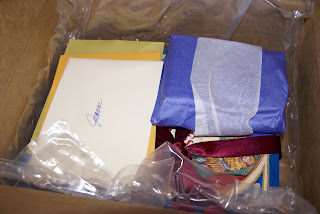 The wonderfully arranged contents reveal themselves.
  Wabi sabi chocolates for me. Imagine - Chocolates made in America using French recipes and a Japanese aesthetic. Does Richelle know me well or what? They come from here.
Here are some of them close up.

The two boys had written in and illustrated wonderful cards.

There were fossilised sea lily stems packaged in gorgeous origami packages made of beautiful patterned paper...

...which Jemimah couldn't resist modelling as a hat.

Finally, there were two wonderful books from Richelle's home business, Barefoot Books. Here is Jemimah checking one of them out. (I'll post about them separately!)
Richelle, Max and Luca, you are incredible. Wow!!
I have met so many wonderful ladies since I began my adventure into blogging. I regard many of you as much more than just readers, and I really appreciate your friendship. I continue to be awe-inspired by your enthusiasm, your support and your willingness to share your life with others. Thank you all.
PS A special mention to those ladies who follow my blog. That is an incredible compliment to me. Thank you so much.
 Making tracks: wheat is loaded into ships at Gellibrand Pier in Williamstown in the 1920s.

Wheat lumper: Jim Farresey carries a bag of wheat from Boyd's farm on to the stack at Nyarrin rail siding in the Mallee in 1923.
We were impressed by the exhibition, but I was more impressed by the quality of our museum. There were slide shows and movies... remember this is the country... a museum in a town of 1200 people you may recall. There were exhibits of farm machinery further illustrating the grain process and bringing the photographs to life.
We'll be returning. Soon.
Be sure to visit if the Paddock to Port exhibition is showing anywhere near you. It is well worthwhile. It might also be worth your while to visit your local museum. You never know, you might get as pleasant a surprise as I did!!
P.S. The great photos are from the exhibition, but I didn't take them. They're from Weekly Times Now.
 My goodness it is hard to put this book down. We really struggle to only read one chapter at a time. And that my friends , is the rule for our family read alouds...all the family together; one chapter at a time.
 The 13 Clocks is written for children, but it's not really a kid's book. What other children's fairy tale story do you know that would say this:
The brambles and the thorns grew thick and thicker in a ticking thicket of bickering crickets. Farther along and stronger, bonged the gongs of a throng of frogs, green and vivid on their lily pads. From the sky came the crying of flies, and the pilgrims leaped over a bleating sheep creeping knee-deep in a sleepy stream, in which swift and slippery snakes slid and slithered silkily, whispering sinful secrets.Did you read it out loud? Go ahead - it is an oral storyteller's dream of a read aloud...the perfect read aloud, perhaps.
He will slit you from your guggle to your zatch...Or how about:
You'll never live to wed his niece. You'll only die to feed his geese. Goodbye, goodnight, and sorry.

To the plot...
The cold and aggressive Duke of Coffin Castle lives with his niece, the beautiful Princess Saralinda. Within the castle walls are thirteen clocks that have stopped at "ten minutes to five". After many failed attempts to get them working again the Duke decides that he has killed Time.
Time lies frozen there.It's always Then. It's never Now.
One day a prince disguised as a minstrel hears about the beautiful Saralinda and decides that she is the beautiful maiden of his dreams. But in order to win her hand, the prince must complete an impossible task for the evil duke.

"I give you nine and ninety hours, not nine and ninety days to find a thousand jewels and bring them here. When you return, the clocks must all be striking five."Does the prince success in his quest? Does he win the beautiful Princess Saralinda? Is there a happy ending? Does everybody live happily ever after?
"The hands are frozen," said the prince. "The clocks are dead."
"Precisely," said the Duke, "and what is more, which makes your task a charming one, there are no jewels that could be found within the space of nine and ninety hours, except those in my vaults and these." He held his gloves up and they sparkled.
You see, at just the right time, when we were still powerless, Christ died for the ungodly. Very rarely will anyone die for a righteous man, though for a good man someone might possibly dare to die. But God demonstrates His own love for us in this: While we were still sinners, Christ died for us.
Romans 5:6-8.
I am somewhat reluctant to put this beautiful tribute song onto my blog. You see, I do believe that there is a greater love and sacrifice than that demonstrated by our Diggers.
More than 100, 000 Australians have paid the ultimate price fighting that I might have freedom and peace. They did not die in vain. Today I remember them - they deserve to be remembered.
There has been a greater sacrifice, though. On a hill called Calvary more than two thousand years ago, Jesus Christ died not for his friends, but for his enemies. Jesus died for sinners.
Our Diggers died for their country. They died so that good people might have freedom. Jesus didn't die for good people; he died for bad ones. We were guilty; we deserved our punishment of death. Jesus died instead of us. Why? Because he loved us. Because of this greatest sacrifice, we can march into eternity with him. Forever.
Today I will humbly and gratefully remember those who have died defending our great country. But I shall also remember Jesus Christ who made the greatest sacrifice of all.
Greater love has no one than this, that he lay down his life for his friends. John 15:13
 Jemimah in a sea of brown daffodil bulbs waiting to be planted
Now that the rain has come, we're busy planting Spring bulbs:
250 King Alfred daffs
100 Dutch iris Discovery
100 Bokassa tulips
100 Muscari in blue
100 hyacinths
That should keep us busy...
PS Note the hat? That's for Hopewell mum!
Farewell Old War Horse
The struggle for freedom has ended they say,
The days of fatigue and Remorse,
But our hearts one and all are in memory today,
We are losing our old friend, the Horse.
The old quadruped that has carried us thro'
The sand ridden caravan track
And shared in the charge of the gallant and true
With the boys who will never come back.
Oh those long weary days thro' a miniature hell
Short of water and nothing to eat,
Each hour we climbed down for a few minutes' spell
And dozed safe and sound and your feet.
When the enemy shrapnel broke overhead,
As we passed up that Valley of Death,
You never once slackened in that hail of lead
Though the boldest of all held their breath.
But we never forgot you, old Comrade and friend,
When the QM Dump hove in sight.
What the Buckshee to Gippo's we scored in the end
And your rations were doubled that night.
Then came the long journey, the greatest of all,
The cavalry stunt of the world.
The sons of Australia had answered the call
And the Ensign of Freedom unfurled.
And now we are leaving you footsore and worn
To the land where the Mitchell grass grew,
Where you frolicked like lambs in the sweet scented morn,
To the song of the Dismal Curlew.
So farewell to the Yarraman old warhorse, farewell,
Be you mulga bred chestnut or bay.
If there's a hereafter for horses as well
Then may we be with you some day.Author unknown - Inspired by the feelings of Australian Light Horsemen who, because of quarantine regulations, had to leave their horses in the Middle East on their return to Australia.

My grandfather, was always a hero to us. Despite having returned from the Great War severely wounded and with two artificial legs, Grandpa had gone on to become a champion cattle breeder, and ably supported his wife, Elsie and their family of six children. We knew that he'd been a hero during war time - he had been awarded the Distinguished Conduct Medal for bravery in the field, but like many of his contemporaries he prefered not to speak of his time at war, and we knew very little of his experiences and exploits in Palestine.
Grandpa died on Christmas Eve 1947. I never knew him.
One day in 1980, one of my cousins who was living in Sydney at that time telephoned my grandmother. He had read in the newspaper that the renowned film writer, Ian Jones was writing a film about Grandpa and his part in the capture of the wells of Beersheeba. What part, we thought. Well, our lives got pretty exciting at that point. It seems that Grandpa really had been a war hero - a recognised one... We had never known.
In 1987 Grandpa's story finally reached the silver screen in The Lighthorsemen.

You can watch part of the film - probably the most exciting part - here:
The short story of his life both during and after the Battle of Beersheeba is written in the book, Just Soldiers, by Darryl Kelly. You can find an adaption of the story about Grandpa from the book online free here.

Following the success of the film, Elyne Mitchell of Silver Brumby fame was asked to write the novel of the movie. Elyne was the perfect choice of author - her father, General Sir Harry Chauvel, had played an important role in the Battle of Beersheba, and for his part in the victory, and the subsequent capture of Jerusalem, Chauvel was created a Knight Commander of the Order of the Bath (KCB) in the 1918 New Years Honours List.
The Lighthorsemen by Elyne Mitchell is out of print, but is available from booksellers in both the USA and Australia through my mate Abe.

This montage is a photo of Sloan and Elsie's descendants taken by my cousin Doug Bolton. It's a few years old now, but see if you can find Jemimah, her dad and me. There are two of me. If anybody can find all four faces, drop me a comment letting me know and describing us. I may just find a prize for the first correct guess, so leave me your name.
Thanks for indulging me in this Anzac post. I'm really proud of my Grandad. I hope that now you may have a little more of an idea of why.
We will remember them


Here's the Editor's Note from the book:
This book of Anzac was produced in the lines at Anzac on Gallipoli in the closing weeks of 1915. Practically every word in it was written and every line drawn beneath the shelter of a waterproof sheet or of a roof of sandbags - either in the trenches or, at most, well within the range of the oldest Turkish rifle, and under daily visitations from the smallest Turkish field-piece. Day and night, during the whole process of its composition, the crack of the Mauser bullets overhead never ceased. At least one good soldier that we know of, who was preparing a contribution for these pages, met his death while the work was still unfinished.

The ANZAC BOOK was to have been a New Year Magazine to help this little British Australasian fraternity in Turkey to while away the long winter in the trenches. The idea originated with Major S. S. Butler, of the A.N.Z.A.C. Staff. On his initiative and that of Lieutenant H. E. Woods a small committee was formed to father the magazine. A notice was circulated on November 11th calling for contributions front the whole population of Anzac. Any profit was to go to patriotic funds for the benefit of the Army Corps.
Between November 15th and December 8th, when the time for the sending in of contributions closed, The ANZAC BOOK was produced. As drawings and paintings began to come in, disclosing the whereabouts of some of the talent which existed in Anzac, a small staff of artists was collected in order to produce head - and tail -pieces and a few illustrations; and a dug-out overlooking Anzac Cove became the office of the only book ever likely to be produced in Gallipoli.
It was after the contributions had been finally sent in, and when the work of editing was in full swing, that there came upon most of us front the sky the news that Anzac was to be evacuated. Such finishing touches as remained to be added after December 19th were given to the work in Imbros. The date for the publication was necessarily delayed. And it was realised by everyone that this production, which was to have been a mere pastime, had now become hundred times more precious as a souvenir. Certainly no book has ever been produced under these conditions before.
 To: Mr Hugh Reid
Tawonga
Via Yackandandah
From: R G Reid
From the Editor's note:
Australia in Palestine is in no sense intended as a complete picture of the Australians' part in the Great Campaign. It is merely a Soldiers' Book, produced almost entirely by soldiers in the field under active service conditions to send to their friends in Australia and abroad.
 The Palestine campaign began with the crossing of the Suez Canal by the Anzac Mounted Division at Kantara on 23rd April 1916, to reoccupy land that had been taken by the Turks. The operations concluded with the Charge of Beersheba and the later capture of Damascus and Aleppo resulting in the complete surrender of the Turkish forces.

You can see a little of the action here:
 This man and his lovely wife are our house guests for the next couple of days. Well actually, they may not be...my Mum and Dad, with whom they are travelling, just phoned to say they're lost, and don't know where they are for me to give directions!! Anyway, presuming that they do eventually find there way to our home, Rev Ken Smith and his wife Floy, along with my parents will be visiting with us. Hence the cleaning - and the cooking - and the washing...our last guests only departed on Sunday, you'll remember...
 Is there a holiday that our family celebrates that doesn't have food attached?
In this time of extraordinary pressure, educational and social, perhaps a mother's first duty to her children is to secure for them a quiet growing time, a full six years of passive receptive life, the waking part of it spent for the most part out in the fresh air.The biggest change in our lives when we discovered Charlotte Mason was her challenge to spend the majority of each day outside:
Charlotte Mason Home Education p 43
I make a point, says a judicious mother, of sending my children out, weather permitting, for an hour in the winter, and two hours a day in the summer months. That is well; but it is not enough. In the first place, do not send them; if it is anyway possible, take them; for, although the children should be left much to themselves, there is a great deal to be done and a great deal to be prevented during these long hours in the open air. And long hours they should be; not two, but four, five, or six hours they should have on every tolerably fine day, from April till October. Impossible! Says an overwrought mother who sees her way to no more for her children than a daily hour or so on the pavements of the neighbouring London squares. Let me repeat, that I venture to suggest, not what is practicable in any household, but what seems to me absolutely best for the children; and that, in the faith that mothers work wonders once they are convinced that wonders are demanded of them. A journey of twenty minutes by rail or omnibus, and a luncheon basket, will make a day in the country possible to most town dwellers; and if one day, why not many, even every suitable day?
Charlotte Mason, Home Education p 43-44
Well, we failed in that lofty ideal miserably, I'm afraid. Jemimah did not spend an average of 5 hours out of doors during the equivalent warm Aussie months of October-April during her first six years. Far from it.
We did, as a consequence of reading these lines, however, make a considerable improvement - simple things that we thought we could stick to.
 1. We eat the majority of our meals out of doors:
On fine days when it is warm enough to sit out with wraps, why should not tea and breakfast, everything but a hot dinner, be served out of doors? For we are an overwrought generation, running to nerves as a cabbage runs to seed; and every hour spent in the open is a clear gain, tending to the increase of brain power and bodily vigour, and to the lengthening of life itself. They who know what it is to have fevered skin and throbbing brain deliciously soothed by the cool touch of the air are inclined to make a new rule of life, Never be within doors when you can rightly be without.
Besides, the gain of an hour or two in the open air, there is this to be considered: meals taken al fresco are usually joyous, and there is nothing like gladness for converting meat and drink into healthy blood and tissue. All the time, too, the children are storing up memories of a happy childhood. Fifty years hence they will see the shadows of the boughs making patterns on the white tablecloth; and sunshine, children's laughter, hum of bees, and scent of flowers are being bottled up for after refreshment.
Charlotte Mason Home Education p 42

2. We have several scheduled breaks during the school day for outside play - this is mostly spent in the sand pit, in our home - or climbing trees (I'm sure Miss Mason would prefer the latter, although she would be rather impressed with the imaginative play that occurs in our garden, I'm sure). In summer you'll often find her in the pool;

3. We participate in some organised sport, allowing Jemimah time outside as well as time with her peers - she swims, plays tennis, and participates in the local Little Athletics programme in Summer, and plays football with Auskick in Winter;
4. We have a full afternoon of 4 or 5 hours outside each week engaging in official nature study as part of our school time; and
5. We attempt to spend a full day out of doors as a family each weekend. This is the secret, I feel, in getting anywhere near the required number of hours up for the week...in our home, certainly. Sometimes we go somewhere special. The Picnic at Hanging Rock that we had on Good Friday is an example of this. Other times we do something close to home.
On Saturday, for example, we climbed a mountain. Yes, truly. A Mountain.

Jemimah relaxing...well okay...posing at the summit - see the summit marker in the background
Okay, then, I'll come clean. On Saturday we climbed ... wait for it - the ...smallest ... registered ... mountain ... in ... the ... world!
It's called Mt Wycheproof.

The view from the summit
You'll find it mentioned on this list of interesting geography facts as the lowest mountain in the world. Its summit is 43 metres (140 feet) above the surrounding plains.

The grain silos - Wycheproof survives on broad acre wheat and barley farming.
Miss Mason speaks earlier of storing up happy memories for our children. I am sure that in later years many of Jemimah's stored memories will consist of days like this.
Do give spending time outside a go - if we can do it anyone can!!
They shall grow not old as we that are left grow old;
Age shall not weary them, nor the years condemn.
At the going down of the sun and in the morning
We will remember them.
This Saturday, the 25th of April, our family will join thousands of Australians to pay tribute to the men and women who fought that we might have freedom in our great land. ANZAC Day is a day of remembrance, a day of national pride, and a day of gratitude and appreciation for all of the men and women who fought and died defending our great country of Australia.
ANZAC Day has great significance to my family. I'm going to take a few days this week to focus on this special day, to share what we do to commemorate, and what's available for us to use with our kids. Thanks for indulging me. I hope you'll find it a useful few days.
The Queensland Cameron Highlanders' tribute in the crypt of the Brisbane Shrine of Remembrance says this:
When you go home tell them of us and say,And so I try - but how do I explain this sense of pride that I feel to Jemimah? How do I pass it to the next generation? How do we explain that we remember the brave soldiers, but do not wish war to come again? How can we instill in our kids a pride in their heritage and a better understanding of the sacrifices made by the brave young men who landed at Gallipoli and those who followed their example in later conflicts?
for your tomorrow we gave our today.
 My Grandad Marches on Anzac Day by Catriona Hoy, makes ANZAC Day accessible to even our preschool aged children. The lump in my throat almost prevented me finishing the book the first time I read it.
Once, long ago, there was a war, my daddy says. Many soldiers fought and died in a place called Gallipoli. Some were from Australia. Some were from New Zealand. They were called ANZACs.In the story, ANZAC Day is seen through the eyes of a young girl who rises early on ANZAC Day to watch her grandad march in the ANZAC Day parade. She shares her day in a realistic way, and Jemimah can easily relate to the little girl and her experiences. She can also relate to the little girl's grandad. She can sense his pride. She can also begin to understand a little about the thousands of man and women who didn't make it home.
They died in places with names like The Nek, Lone Pine and Anzac Cove.
Their mums and dads waited, but they never came home.
My grandad marches...
to remember them.
My grandad marches...to remember them.I thoroughly recommend this book. It is one of our family's favourites. It also started our ANZAC Day hot chocolate tradition!!

I have learnt to be man through all of this...and I will do what must be done, for I have learnt to see life though my mother’s eyes.William is only fifteen when he lies about his age (like so many other boys) and enlists during the First World War. He is accepted into the Australian Imperial Forces (AIF) and is sent as a boy soldier sent to the battlefields of France.
A whistle blew...
We don't really know what happens near the end. In a book written for primary aged kids, it's probably better that way. The book gives the impression that William’s family will be one of the thousands torn asunder by the futility of war, that he will never return home.
It's a sad book. I choked up when I read this one too. Now I know I get rather emotional when I read stories about war, but this one touched me in the same way that Cationa Hoy's book did. It made me feel proud and sad and indebted. It made me remember why we remember these brave men and women who gave their lives fighting that I might have peace.
We don't remember them because we want to be like them - we remember them so that we never have to.
More tomorrow.


