I bought a new pair of jeans on Saturday. The old ones were too tight.
I don't know which is worse - a larger sized pair of jeans hanging in my wardrobe or a muffin top.
Sigh. It is bad whichever way you look at it.
Perhaps I'd better start wearing caftans.
31 Aug 2009

Make Way For Ducks

Farmer Schulz lived on the beautiful Onkaparinga River in South Australia. He was a busy man and his farm was a busy place. There were cows and geese and goats and vegetables and fruit trees and cellars full of German sausage and dishes of scalded cream. And in the yard at the back of the house there were more than fifty ducks.
Farmer Schulz's ducks were the loveliest ducks in the whole world.

Every morning after breakfast Farmer Schultz would open the backyard gate so that the ducks could go down the drive and across the road and down to the Onkaparinga River. The cars would stop for the ducks because everyone knew that the ducks had right of way.
Then the city beyond the hills began to grow and along with it came the traffic.
Sometimes they didn't even stop for ducks!
Farmer Schulz called the family together to think of a solution.

The Schulz's come up with many solutions - the bridge is one of them. Will it work? Will the ducks get across the road and into the water or do the family finally give up on the ducks?
You'll need to buy the book to find out, won't you?
It's called Farmer Schulz's Ducks and it's by Colin Thiele. It is out of print (of course!) but is available here and here. (It is difficult to find in secondhand bookshops although I found one eventually.) The book was shortlisted by the Children’s Book Council of Australia for the 1987 award as Book of the Year for Younger Readers.
Colin Thiele's books are often written for older kids. With this book I've had children as young as three hanging on every word. It is truly delightful.
Robert McCloskey's Make Way For Ducklings is a wonderful contrast to this book. McCloskey's Caldecott Medal winning book tells the story of a family of ducks who have to cross a busy Boston street.
City-Country.
America-Australia.
The two work wonderfully together.
Ruth Marshall has a book study on Farmer Schulz's Ducks that you might like to check out. You can read more from me on Colin Thiele too, if you want to.
29 Aug 2009
Lovely!
Image from here.
 We're off to the Pancake Parlour for lunch.
Lovely!
 We're off to the Pancake Parlour for lunch.
Lovely!
A visit to this Melbourne institution was one of my favourite treats as a child - it has been going since 1965 - and it's now one of Jemimah's as well. Like me, she loves playing chess at the giant chess board and reading the funny menu. Dining is certainly not boring at the Pancake Parlour!!
I still have the same thing I chose as a child of seven: Jamaican Banana Pancake and a Muddled Lemon to drink. Yum.
What's your favourite? Do you still go to one of your childhood restaurants?
Another thing - why, when we've eaten out at some of the best restaurants in the world, do we still love a pancake chain? Perhaps this is a deep dark secret that one shouldn't admit to in cyberspace?
Oh well...
28 Aug 2009
Goodness, Google!
According to my stats, people find my blog in many different ways. Often it is by chance, using Google search.
It seems that if you search 'Charlotte Mason Australia' you find me. No surprise there. 'MEP' might lead you here too.
This one has got me stumped though...
Last night somebody from Singapore found my blog by googling 'n*de chinese girls'!
Oh my goodness, Google.
Apparently, if you google the following terms you might find me too:
It seems that if you search 'Charlotte Mason Australia' you find me. No surprise there. 'MEP' might lead you here too.
This one has got me stumped though...
Last night somebody from Singapore found my blog by googling 'n*de chinese girls'!
Oh my goodness, Google.
Apparently, if you google the following terms you might find me too:
- waatji pulyeri
- For with thee is the fountain of life; in thy light shall we see the public option.
- the dog sat on the tuckerbox
- Roy And Matilda
- ANZAC Biscuits
- Sana'a Yemen
- Christian Northeast Found Prayers
- Cyclone Aila
- The Cove
- Using Youtube to teach French
- Trooper Scotty Bolton
- Hoppipolla Jumping into Puddles
Sorry Google, you are sometimes not omniscient. You will find nothing on The Cove here. There is nothing on Christian Northeast's book either.
And there totally is not a single thing on n*de chinese girls. Not even a bikini.
Later:
Oops! I've just come back to edit this post by removing the 'u' and replacing them with '*'. Otherwise googling that term will point to my blog for real, and I certainly don't want to increase my traffic that way!!
Hope I'm not too late.
27 Aug 2009
Tony Takitani
Oh my! Look what I found on Hiki's site tonight? Doesn't it look and sound dreamily ethereal?
You can read all about it on Jollygoo.
Chocky Crackles - Mmmmm
 I realised that I'd been a bad mother today when I discovered that Jemimah didn't know what a Chocolate Crackle was. How could she get to seven and not know that? Chocolate Crackles are the ultimate Australian children's party food - aren't they?
I guess not. It has been a number of years since I kept a packet of Copha in the fridge just because. These days there is not a lot of call for shortening.
Copha is out of fashion, along with lard and suet and butter. It has gone the way of the jar of dripping that sat the side of my mother's stove. FAT IS BAD FOR YOU! When the dripping disappeared so did Mum's roast beef sandwich. Along with the suet went Gooseberry Pudding. Nowadays it is hard to find suet at Christmas time...and I lurve suet pudding!! But I digress.
Chocolate Crackles.
You can't go through childhood without cooking chocolate crackles. It's un-Australian. That's what it is.
I rectified my error this very day.
Jemimah made them alone. She read the recipe (reading). She measured the ingredients (maths). She observed the way the fat melted (science). She cooked (kitchen garden). She had a ball (fun)!
You can see them in the pic. They're really quite good!
They're full of Copha. Copha is bad for you. It is solidified coconut oil and is a solid at room temperature. It's hydrogenated. That means that it is treated with hydrogen, changing the unsaturated fat bonds to saturated ones. That makes it even worser for you!
Chocolate Crackles are not healthy. That's not the point. They're delicious, and if you have them once every seven years, who cares if they're healthy or not?
I don't really need to give the recipe - it's on the Copha packet. If you can't get Copha then you can't really make Chocky Crackles. You'd better make something else instead. Something you can make and I can't...
If you're in Australia you are in luck. New Zealanders can get this wonderful product too. Yours is called Kremelta. The German version is Palmin.
So for the New Zealanders and Germans here's the recipe:
1 block Copha (250g)When did eating get so serious, I ask you. Eating used to be fun.
4 cups Kellogg's Rice Bubbles
1 cup icing sugar
3 tablespoons cocoa
1 cup desiccated coconut
Mix dry ingredients.
Melt Copha over low heat and allow to cool a little. Add to dry ingredients.
Stir.
Spoon the mixture into patty pans and set in the refrigerator.
Makes 24 biggies or 49 littlies. We like littlies better - the biggies are too rich for those of us who are deprived and rarely eat a diet high in fat.
As it turns out, Jemimah did know what Chocolate Crackles were once she'd tasted them. Turns out I'm not such a bad mother after all.
At least I got to eat some Chocky Crackles.
Ends and Beginnings
Something pretty funny happened yesterday. Well, I thought it was funny, so I thought I'd share...
Last night our homegroup finished a ten week study called The Blueprint by Matthias Media.

Next week we begin a new study on Revelation written by our minister.
Yesterday morning Jemimah finished a 77 day study for Devotions called The Big Book of Questions & Answers by Sinclair Ferguson.
 Today we started Discovering Jesus in Genesis by Susan Hunt and Richie Hunt.
 Yesterday I finished (yay!) my Welwyn Commentary on Judges and Ruth Even in Darkness by Gordon Keddie.
 Tonight I start Doing a Great Work by Stan Evers. (Aren't you proud of me!!)
 Last night we finished our family devotional, My Picture Story Bible by Dena Korfker. It's over 500 pages long - we've been using it for more than 18 months.

Tonight we start The Tent of God by Marianne Radius. (Catherine and Geerhardus Vos' daughter.)

Last night our homegroup finished a ten week study called The Blueprint by Matthias Media.

Next week we begin a new study on Revelation written by our minister.
Yesterday morning Jemimah finished a 77 day study for Devotions called The Big Book of Questions & Answers by Sinclair Ferguson.
 Today we started Discovering Jesus in Genesis by Susan Hunt and Richie Hunt.
 Yesterday I finished (yay!) my Welwyn Commentary on Judges and Ruth Even in Darkness by Gordon Keddie.
 Tonight I start Doing a Great Work by Stan Evers. (Aren't you proud of me!!)
 Last night we finished our family devotional, My Picture Story Bible by Dena Korfker. It's over 500 pages long - we've been using it for more than 18 months.
Tonight we start The Tent of God by Marianne Radius. (Catherine and Geerhardus Vos' daughter.)

What are the chances of all of these coinciding on the one day? Pretty huge, I reckon!!
Just for completion because it didn't happen yesterday but on Sunday, we completed our Adult Bible Class study on the Life and Influence of John Calvin.
Yep, you guess it - on Sunday we'll start something new!!
Watch for some reviews coming soon!!
25 Aug 2009
CM Picture Study & Salvador Dalí
Salvador Dalí: Liquid Desire, the first comprehensive retrospective of the work of Salvador Dalí ever to be staged in Australia, is on at the National Gallery of Victoria at present. We went to see it when it first opened. It was fantastic!
I tried to blog about it at the time of our visit, and three hours work disappeared into cyberspace. You may recall that I was rather bitter and twisted about it at the time. It has taken until now to attempt a rerun. I had to revisit the subject at least for my own use, because we plan on studying Dalí for Picture Study this term and I had to decide what art pieces we would actually look at! I have saved this blog post at every paragraph. True!
Charlotte Mason has quite a lot to say about Picture Study. I don't know whether her methods were progressive or controversial for the times in which she wrote, but she goes into significant detail on the subject in at least three of her volumes. She even goes as far as to provide notes on how the lessons should be given!
Here's a sampling:
If you have your hand up right now, I'm going to encourage you to give Picture Study a go. Right now - today. Or tomorrow if it's night time. Some time really soon anyhow. It really is a soothing balm in a busy week. Like nature study it provides relief from academic study, and is often the subject we turn to to sooth frayed nerves and restore peace. It requires concentration but it brings great and lasting pleasure.
Ambleside Online's Artist Rotation is excellent. Prints to study are identified by the Advisory each term and a couple of mums create pdf files for you to download and print yourself from yahoo groups. Angela's are here. I use Judy's, which are here. I don't know about Angela, but Judy provides the prints in several sizes, including thumbnails perfect for timeline books.
Australia has a number of excellent artists, and so we substitute one of the AO rotation for an Australian artist each year.
Once a week for five minutes or so Jemimah looks at the painting. Really looks - with a seeing eye. Then she turns the paper over and tells me what she's seen. Sometimes she reproduces the painting as a sketch:
You can see a drawn narration by a 6 yo Jemimah here. Here's a spoken narration given for her end of term exams recently. She is 7 ½ (The ½ is very, very important when you're 7 ½ - don't you know that!). It had been ten weeks since she had last seen the picture.
That's about it - thirteen years; 39 good artists; 234 paintings. Easy!
Or is it? The problem is, real life intervenes on the ideal. It always does. In the case of Picture Study the thing that most often disrupts the nice simple Ambleside Online rotation is personal preference. That and travelling exhibitions. You see, if your favourite artist isn't represented you're going to want to include him (or her, just to be politically correct.) If you hate an artist you'll probably want to leave him out - unless your kids love him, of course...
Similarly, if your local gallery has an exhibition of the work of an artist that you're not going to study for another two years, are you going to stay at home, or are you going to adjust your schedule to accommodate him? If the artist is a great one - a Monet or a Rembrandt or a Da Vinci then the answer is simple, isn't it? Of course you'll take advantage of the exhibition. After all, you're a homeschooler right? You're characterised by dragging your kids along to things of culture and value.
What if the artist not on the list though? What if he's controversial? What if - horror of horrors - you don't actually like him? What if the artist is Andy Warhol the pop-art king? Is he worth studying? (I actually remember one mum asking that exact question of the AO yahoo group a year or so ago.)
What if the artist is Salvador Dalí?
Dali was very weird:
Much of Salvador Dalí's art was pretty weird too:
I had never liked Salvador Dalí. He was too extreme, too odd. He had a strange lifestyle and was obsessed with...well obsessed with things I didn't approve of. His paintings were weird too. After the exhibition things changed. The main thing was that my 7 yo loved this strange man's art! Really loved it.
So this term we're studying Salvador Dalí. I don't think Dalí's lifestyle will edify Jemimah, so we won't be talking much about that. I don't think his erotic or worse - to me - perverted art will build up my daughter either. But at this exhibition of more than 200 stunning pieces of art I discovered plenty of pieces of art that possessed what Mrs Evans was alluding to: pieces that supply an education to the eye, and raise the standard of taste by association in unconscious youth.
If you want to follow along, these are the pieces we're studying:
I tried to blog about it at the time of our visit, and three hours work disappeared into cyberspace. You may recall that I was rather bitter and twisted about it at the time. It has taken until now to attempt a rerun. I had to revisit the subject at least for my own use, because we plan on studying Dalí for Picture Study this term and I had to decide what art pieces we would actually look at! I have saved this blog post at every paragraph. True!
Charlotte Mason has quite a lot to say about Picture Study. I don't know whether her methods were progressive or controversial for the times in which she wrote, but she goes into significant detail on the subject in at least three of her volumes. She even goes as far as to provide notes on how the lessons should be given!
Here's a sampling:
The wealth of detail included in Miss Mason's volumes makes it clear the importance she placed on this little study. What do we notice?The art training of children should proceed on two lines. The six-year-old child should begin both to express himself and to appreciate, and his appreciation should be well in advance of his power to express what he sees or imagines. Therefore it is a lamentable thing when the appreciation of children is exercised only upon the coloured lithographs of their picture -books or of the 'Christmas number.' But the reader will say, 'A young child cannot appreciate art; it is only the colour and sentiment of a picture that reach him. A vividly coloured presentation of Bobbie's Birthday, or of Barbara's Broken Doll, will find its way straight to his "business and bosom."' 'Therefore,' says the reader, 'Nature indicates the sort of art proper for the children!' But, as a matter of fact, the minds of children and of their elders alike accommodate themselves to what is put in their way; and if children appreciate the vulgar and sentimental in art, it is because that is the manner of art to which they become habituated.
Charlotte Mason, Home Education p 307-8
When children have begun regular lessons (that is, as soon as they are six), this sort of study of pictures should not be left to chance, but they should take one artist after another, term by term, and study quietly some half-dozen reproductions of his work in the course of the term.
The little memory outlines I have quoted show his studies; but this is the least of the gains. We cannot measure the influence that one or another artist has upon the child's sense of beauty, upon his power of seeing, as in a picture, the common sights of life; he is enriched more than we know in having really looked at even a single picture. It is a mistake to think that colour is quite necessary to children in their art studies. They find colour in many places, and are content, for the time, with form and feeling in their pictures.
Charlotte Mason, Home Education p308-9
It will be noticed that the work done on these pictures is done by the children themselves. There is no talk about schools of painting, little about style; consideration of these matters comes in later life, but the first and most important thing is to know the pictures themselves. As in a worthy book we leave the author to tell his own tale, so do we trust a picture to tell its tale through the medium the artist gave it. In the region of art as else-where we shut out the middleman.
Charlotte Mason, A Philosophy of Education p 216
How do we prepare a child, again, to use the aesthetic sense with which he appears to come provided? His education should furnish him with whole galleries of mental pictures, pictures by great artists old and new;––Israels' Pancake Woman, his Children by the Sea; Millet's Feeding the Birds, First Steps, Angelus; Rembrandt's Night Watch, The Supper at Emmaus; Velasquez's Surrender of Breda, - in fact, every child should leave school with at least a couple of hundred pictures by great masters hanging permanently in the halls of his imagination, to say nothing of great buildings, sculpture, beauty of form and colour in things he sees.
Charlotte Mason, A Philosophy of Education p 43
- Children should have regular Picture study lessons by the age of six.
- Children do not need children's art - their minds will adapt to whatever comes their way. If children appreciate poor art then it is because this is what they have seen.
- Children should study one six or so pieces by the one artist over a period of a term.
- Do not 'teach' art appreciation - let the pictures speak for themselves and leave out the middleman.
If you have your hand up right now, I'm going to encourage you to give Picture Study a go. Right now - today. Or tomorrow if it's night time. Some time really soon anyhow. It really is a soothing balm in a busy week. Like nature study it provides relief from academic study, and is often the subject we turn to to sooth frayed nerves and restore peace. It requires concentration but it brings great and lasting pleasure.
Ambleside Online's Artist Rotation is excellent. Prints to study are identified by the Advisory each term and a couple of mums create pdf files for you to download and print yourself from yahoo groups. Angela's are here. I use Judy's, which are here. I don't know about Angela, but Judy provides the prints in several sizes, including thumbnails perfect for timeline books.
Australia has a number of excellent artists, and so we substitute one of the AO rotation for an Australian artist each year.
Once a week for five minutes or so Jemimah looks at the painting. Really looks - with a seeing eye. Then she turns the paper over and tells me what she's seen. Sometimes she reproduces the painting as a sketch:
The castle was there, see. Up here was a knight on a horse, and over there was his lady fair. It was springtime - the tree had pink blossoms...Something like that (only she probably wouldn't have worded it exactly like that...). Sometimes she tries painting it and doesn't give a verbal narration at all. The next week we use the same painting again. The following one we move on to something new. Occasionally we will read a book or have a chat about the artist's life and where and when he worked. At some stage during the term we add Jemimah's favourite painting to her Book of Centuries.
You can see a drawn narration by a 6 yo Jemimah here. Here's a spoken narration given for her end of term exams recently. She is 7 ½ (The ½ is very, very important when you're 7 ½ - don't you know that!). It had been ten weeks since she had last seen the picture.
That's about it - thirteen years; 39 good artists; 234 paintings. Easy!
Or is it? The problem is, real life intervenes on the ideal. It always does. In the case of Picture Study the thing that most often disrupts the nice simple Ambleside Online rotation is personal preference. That and travelling exhibitions. You see, if your favourite artist isn't represented you're going to want to include him (or her, just to be politically correct.) If you hate an artist you'll probably want to leave him out - unless your kids love him, of course...
Similarly, if your local gallery has an exhibition of the work of an artist that you're not going to study for another two years, are you going to stay at home, or are you going to adjust your schedule to accommodate him? If the artist is a great one - a Monet or a Rembrandt or a Da Vinci then the answer is simple, isn't it? Of course you'll take advantage of the exhibition. After all, you're a homeschooler right? You're characterised by dragging your kids along to things of culture and value.
What if the artist not on the list though? What if he's controversial? What if - horror of horrors - you don't actually like him? What if the artist is Andy Warhol the pop-art king? Is he worth studying? (I actually remember one mum asking that exact question of the AO yahoo group a year or so ago.)
What if the artist is Salvador Dalí?
Dali was very weird:
Much of Salvador Dalí's art was pretty weird too:
 The Shoe (Surrealist Object Functioning Symbolically) 1974
Back in 1900 a CM mum addressed this very issue in a PRArticle - not about Andy or Salvador, of course, but the problem is the same - controversial or difficult art:
This then is what we are looking for, perhaps - that quality in an artist's work that supplies an education to the eye, and raises the standard of taste by association in unconscious youth. So, if the visiting artist is recognised as producing quality work which will edify and build up your student then the artist is worth studying. That's my opinion anyhow. (Mrs Evans' too, I s'pose!)A lady, a very cultivated and charming person, once told me that much pleasure in art in her after life was due to her having had constantly before her, as a child in her father's house, some good engravings from Raphael's cartoons.
Raphael's cartoons are large water-colour drawings, scenes from the Acts of the Apostles, they were made as designs for tapestry for the Pope's chapel in Rome; seven out of the original ten are the property of our Queen, and are to be seen at South Kensington Museum. Apart from their sacred subject, these designs are interesting as representing character and dramatic expression of all human emotion. They are grand-looking compositions, showing surprise, joy, awe, adoration, indignation, fear and love, with that dignity of aspect which we name divine.
You will protest that only unusually developed children will understand such pictures or care for them, especially when presented in the black-and-white of engraving. I will add that there are many grown-up people who will not understand such pictures apart from the subject, but if these grown-up people had been habituated as children to the sight of such grand works of art , their eyes would have been unconsciously educated into following certain forms and sequences of forms, the exquisite harmony of line and composition (or grouping), which is to the eye as music to the ear; the rich depths of shade, the delicate gradation of light in a good engraving, give a pleasure approximate to the pleasure of colour to an educated eye, and early association is an unconscious constant force in this education of the eye. The eye accustomed from youth upwards to drinking in these harmonies of line and of light, will instinctively turn from the discordant and vulgar in art, as the trained musical ear shrinks from false notes.Note the sequence of line in the Raphael cartoon of "The Miraculous Draught of Fishes," the line of the over-laden boats, rather too small for nature, but purposely made so by an artist's license in fitting his subject into the decorative limits of his space; how this line leads the eye to the shore and the distant city, a contrast to the lonely part of the lake in which the fishermen have caste their net. The herons are here to pick up the fish that escape from the laden boats and the meshes of the net, but Raphael has put them just where they are in order to fill up a space in the design , to avoid monotony, by thus breaking in upon and contrasting with the lower lines of the composition. The pleasing purely decorative effect of this incident is equal to anything we can find in the vaunted art of Japan. The figures stooping to the drag of the net might have been, in the hands of lesser artist, mere exercises in anatomy, but they are, however, realistically strained by their burden of the miraculous draught of fish, graceful and beautiful. Take the chief lines of the group apart from their human meaning, they form almost a symmetrical pattern, and it is this symmetry, repetition, variety, harmony, that gives pleasure to what is called the aesthetic sense, the sense of beauty in any art and in nature.
I analyse in part the composition of this one picture to show you what I mean by its purely aesthetic value, apart from its human subject and emotional significance, what a recent critic, Berenson, has dilated upon as the decorative and permanently interesting qualities, as distinguished from the merely illustrative. Throughout this composition there are sequences of flowing lines and ordered masses and spaces, beautifully varied, and yet harmonious as the perfect chords of a violin. It is this quality in a work of art which supplies an education to the eye, and raises the standard of taste by association in unconscious youth.
How to Show Children Our National Gallery, A. R. Evans.Parents' Review Article Volume 11, no. 4, 1900, pp 216-227
.jpg)
I had never liked Salvador Dalí. He was too extreme, too odd. He had a strange lifestyle and was obsessed with...well obsessed with things I didn't approve of. His paintings were weird too. After the exhibition things changed. The main thing was that my 7 yo loved this strange man's art! Really loved it.
So this term we're studying Salvador Dalí. I don't think Dalí's lifestyle will edify Jemimah, so we won't be talking much about that. I don't think his erotic or worse - to me - perverted art will build up my daughter either. But at this exhibition of more than 200 stunning pieces of art I discovered plenty of pieces of art that possessed what Mrs Evans was alluding to: pieces that supply an education to the eye, and raise the standard of taste by association in unconscious youth.
If you want to follow along, these are the pieces we're studying:
 La persistencia de la memoria 1931 or The Persistence of Memory (This is probably his most famous painting.)
 Las Ovejas or The Sheep 1942 (Additions on a print by Schenck)
 Study for Fifty abstract paintings which as seen from two yards, change into three Lenins masquerading as Chinese and as seen from six yards, appear as the head of a Royal Bengal Tiger c. 1962

Portrait of my sister 1925
 Slave market with apparition of the invisible bust of Voltaire 1940
 Dream Caused by the Flight of a Bumblebee around a Pomegranate a Second Before Awakening 1944 I realise that some won't like the nude picture of Gaia in this piece. It is one of Jemimah's favourites - the first Dalí piece she ever saw - and the one that made us go to see the exhibition in the first place. Feel free to substitute!
We'll also look at the two pieces above - the advertisement and the surrealist object, as well as this beautiful piece:
Finally we'll watch Destino animated Dalí - amazing!
I've got some kids' books too:
Dali and the Path of Dreams by Anna Obiols
Dali And Other Secrets by Marta Luna (Now available in English ) Victorians - you can get this book from the NGV Bookshop but I didn't see it on the website.
I'm going to stop now. Can you see why I was upset when the other post disappeared?
It's gunna be an exciting term. Do join us!
Horse Crazy
I think a certain horse obsessed seven year old might quite like the Horse Crazy books written by wonderful Aussie author Alison Lester and illustrated by the equally talented Aussie illustrator Roland Harvey. Has anybody seen them? Anyone's kids read them?
In Book 1, The Silver Horse Switch we meet Bonnie and Sam. The two girls are best friends, and they're both Horse Crazy! The girls know all the horses in their small Australian town of Currawong Creek: Whale, Biscuit, Bella, Blondie and Tex, just to name a few. They befriend them all. All except Drover. Drover used to be a wild horse - a brumby - and Drover is not friends with Bonnie and Sam. Drover is not friends with anyone.
Then one day the two girls notice something strange about Drover. They begin to suspect that Drover might not be Drover at all...
24 Aug 2009
AO2 Term 2 Exams
Bible
1. In your own words, tell as much as you can remember about Moses and Israel in the Wilderness
2. Scripture catechism questions on Moses – can you remember them all?
3. Tell me all about John the Baptist.
4. Can you remember your Scripture catechism questions about John?
Memory
1. Recite Psalm 19 to Daddy.
2. Westminster Catechism questions. How many can you get right?
3. Can you recite The Man from Snowy River?
4. Récites Genèse 1:1 et Psaume 19:1 en français à Maman.
Writing
1. Write the alphabet in lower case letters in your very best writing.
2., Please write, using your very best writing: “Pack my box with five dozen liquor jugs.” Watch punctuation, slope and spacing.
Reading
1. Read for 5 minutes from The Miraculous Journey of Edward Tulane (700L)
2. Read for 5 minutes from A Wrinkle in Time (740L)
World History
1. What can you tell me about Bibles made of Stone and Glass?
2. Tell the story of Edward III of Winsor and the Siege of Calais.
3. How did Richard, the little duke escape from the King of France, and what happened next?
4. Illustrate one of the following:
a. Peter Waldo and the Waldensians;
b. Francis of Assisi; or
c. Bernard of Clairvaux.
Natural History and General Science
1. What have you learned about Pagurus, and how he grows to ‘become’ a hermit crab?
2. What has Seabird learned about whales?
3. What has been your favourite nature study topic and why?
4. Draw a picture of this animal / plant and label it in French.
5. Show your nature study book to Daddy and explain it to him.
6. Show your Astronomy notebook to Daddy and tell him some interesting things about the moon.
Literature and Tales
1. Tell the story of “All’s Well that Ends Well” or “Cymbeline”.
2. Tell the story of how Toad escaped from prison and got home to his friends again.
3. Which was your favourite character and why?
4. What happened to Pilgrim and Faithful at Vanity Fair?
5. Tell the story of one of the following:
a. The Dragonfly Grub in “Not Lost, but Gone Before”;
b. The Weather-cock and the Sundial in “Active and Passive”or
c. The Sea and the Vapours in “The Circle of Blessing.”
Australian literature/geography
1. Which of the people Del and Bushbo met in their travels was your favourite? Tell about what happened when they met.
2. Can you show me on a map where he lives?
3. Tell me about Wurrunna the Daen and some of the adventures he had on his travels to strange places.
Mathematics
1. Complete review sheet 40
2. Complete French maths sheet – Problèmes pour chercher.
4. Count as high as you can in French in tens.
5. Recite your eight times table.
French
1. Have a look at this picture of animals in the country and describe in French.
3. Sing the song, A quelle heure part le train and explain what it’s about.
Picture Study (Sidney Nolan)
1. What is the name of the artist we studied this term? Where did he live?
2. Describe your favourite picture from this term's picture study and explain why you like it.
3. Can you draw one of his others?
Composer Study (Vivaldi)
1. What is the name of the composer we have been studying this term? What can you tell me about his life?
2. Tell me a bit about the orphanage he worked at.
Music
1. Sing all the songs from this term in front of Daddy.
2. Play three songs on the recorder, including one that uses your new notes.
Handwork
1. Show Daddy your knitted purse.
2. Do you know the names of the stitches you used?
1. In your own words, tell as much as you can remember about Moses and Israel in the Wilderness
2. Scripture catechism questions on Moses – can you remember them all?
3. Tell me all about John the Baptist.
4. Can you remember your Scripture catechism questions about John?
Memory
1. Recite Psalm 19 to Daddy.
2. Westminster Catechism questions. How many can you get right?
3. Can you recite The Man from Snowy River?
4. Récites Genèse 1:1 et Psaume 19:1 en français à Maman.
Writing
1. Write the alphabet in lower case letters in your very best writing.
2., Please write, using your very best writing: “Pack my box with five dozen liquor jugs.” Watch punctuation, slope and spacing.
Reading
1. Read for 5 minutes from The Miraculous Journey of Edward Tulane (700L)
2. Read for 5 minutes from A Wrinkle in Time (740L)
World History
1. What can you tell me about Bibles made of Stone and Glass?
2. Tell the story of Edward III of Winsor and the Siege of Calais.
3. How did Richard, the little duke escape from the King of France, and what happened next?
4. Illustrate one of the following:
a. Peter Waldo and the Waldensians;
b. Francis of Assisi; or
c. Bernard of Clairvaux.
Natural History and General Science
1. What have you learned about Pagurus, and how he grows to ‘become’ a hermit crab?
2. What has Seabird learned about whales?
3. What has been your favourite nature study topic and why?
4. Draw a picture of this animal / plant and label it in French.
5. Show your nature study book to Daddy and explain it to him.
6. Show your Astronomy notebook to Daddy and tell him some interesting things about the moon.
Literature and Tales
1. Tell the story of “All’s Well that Ends Well” or “Cymbeline”.
2. Tell the story of how Toad escaped from prison and got home to his friends again.
3. Which was your favourite character and why?
4. What happened to Pilgrim and Faithful at Vanity Fair?
5. Tell the story of one of the following:
a. The Dragonfly Grub in “Not Lost, but Gone Before”;
b. The Weather-cock and the Sundial in “Active and Passive”or
c. The Sea and the Vapours in “The Circle of Blessing.”
Australian literature/geography
1. Which of the people Del and Bushbo met in their travels was your favourite? Tell about what happened when they met.
2. Can you show me on a map where he lives?
3. Tell me about Wurrunna the Daen and some of the adventures he had on his travels to strange places.
Mathematics
1. Complete review sheet 40
2. Complete French maths sheet – Problèmes pour chercher.
4. Count as high as you can in French in tens.
5. Recite your eight times table.
French
1. Have a look at this picture of animals in the country and describe in French.
3. Sing the song, A quelle heure part le train and explain what it’s about.
Picture Study (Sidney Nolan)
1. What is the name of the artist we studied this term? Where did he live?
2. Describe your favourite picture from this term's picture study and explain why you like it.
3. Can you draw one of his others?
Composer Study (Vivaldi)
1. What is the name of the composer we have been studying this term? What can you tell me about his life?
2. Tell me a bit about the orphanage he worked at.
Music
1. Sing all the songs from this term in front of Daddy.
2. Play three songs on the recorder, including one that uses your new notes.
Handwork
1. Show Daddy your knitted purse.
2. Do you know the names of the stitches you used?
Our mutual admiration society
Did you have a group of best girlfriends at school? You know the type, the ones who hung together during recess and had sleepovers at each other's homes on the weekend - often together as a group. The type that shared clothes - and boyfriends - and secrets - that talked all day at school and on the phone all evening. The ones that did everything together - happily. Did you?
Do you now? Are you part of a group of friends that go out together for meals or to the pictures or for drinks, or for whatever it is you do? Perhaps it's a church group - or perhaps its the same group that you had at school. It doesn't matter really, I'm just wondering if you had a group of friends like this.
I didn't. I was - and am - more of a loner - a serial monogamist as it were. I moved from one best friend at school to another best friend at University to another best friend at work and on to another best friend who remains my best friend to this day, even though she now lives far away. I keep the rest of my friends at arms length. Except my husband of course. He's my best friend of all.
I think part of the reason that I prefer this type of relationship is that I am a listener not a talker. I like to support my friends on a one on one basis, and I almost never talk about my self. As I mentioned in my 25 random things about me post I am pathologically private. I think I might be quite odd actually, but that's the way I am.
Then along came blogging. Unless I was going to have blank pages, suddenly I had to start talking about things - about my family, my beliefs, my thoughts - about me! There are things I don't talk about, of course - our older two children, my hubby (except anonymously and peripherally) and our work. I don't talk about the bad days either (mostly).
I do talk about me.
If you read my blog regularly, you know more about me than most of my real life friends. More than my family about some things. And you know, I really like it!! I love my group of blogging girlfriends, and I really value your opinions. I feel like you really care what's going on in my life - and I know that I care what happens in yours too.
Two of that group of girlfriends gave me awards on the weekend. Jillian from Homeschooling4Christ cared enough to give me the Loyalty and Friendship Award. This award is to be passed on to those who faithfully follow my blog, giving encouragement and forming friendships that help us to build one another up in the Lord. That is an overwhelming honour, Jillian. Thank you.
Do you now? Are you part of a group of friends that go out together for meals or to the pictures or for drinks, or for whatever it is you do? Perhaps it's a church group - or perhaps its the same group that you had at school. It doesn't matter really, I'm just wondering if you had a group of friends like this.
I didn't. I was - and am - more of a loner - a serial monogamist as it were. I moved from one best friend at school to another best friend at University to another best friend at work and on to another best friend who remains my best friend to this day, even though she now lives far away. I keep the rest of my friends at arms length. Except my husband of course. He's my best friend of all.
I think part of the reason that I prefer this type of relationship is that I am a listener not a talker. I like to support my friends on a one on one basis, and I almost never talk about my self. As I mentioned in my 25 random things about me post I am pathologically private. I think I might be quite odd actually, but that's the way I am.
Then along came blogging. Unless I was going to have blank pages, suddenly I had to start talking about things - about my family, my beliefs, my thoughts - about me! There are things I don't talk about, of course - our older two children, my hubby (except anonymously and peripherally) and our work. I don't talk about the bad days either (mostly).
I do talk about me.
If you read my blog regularly, you know more about me than most of my real life friends. More than my family about some things. And you know, I really like it!! I love my group of blogging girlfriends, and I really value your opinions. I feel like you really care what's going on in my life - and I know that I care what happens in yours too.
Two of that group of girlfriends gave me awards on the weekend. Jillian from Homeschooling4Christ cared enough to give me the Loyalty and Friendship Award. This award is to be passed on to those who faithfully follow my blog, giving encouragement and forming friendships that help us to build one another up in the Lord. That is an overwhelming honour, Jillian. Thank you.
 Grace from Beyond the Black Stump has given A Peaceful Day the My Favourite Blogs Award (well it is favorite, but I like the 'u'!) There are so many amazing blogs out there, to be though of as a favourite is actually a bit overwhelming. Thanks Grace, truly.
 So these two awards I want to pass onto my group of girlfriends - the very first 'group' of friends I have ever had! We are sort of a mutual admiration society really, aren't we?
I know I'm going to miss someone if I name names so I won't. Well I'll just name four. To Sarah and Louise who have gone on to become friends in real life as well as in cyberspace, and to Jeana who already was, I thank you for your friendship, both in real life and through the pages of my blog. And to Richele who everyone knows is my special friend, thank you for caring.
The rest of you know who you are. We speak on almost a daily basis, and I appreciate your support more than you can know. Thank you all. These awards are for you.
Perfume and insense bring joy to the heart, and the pleasantness of one's friend springs from his earnest counsel. Proverbs 27:9
Two Lovely Blog Awards
Image by Hiki at Jollygoo
 Do you think my blog is lovely?
Hiki and Heather both do.
To receive an award from these two ladies is particularly humbling. Heather's award was a real surprise, because her blog, Well Read is a new one to me. It is a special honour to receive recognition from afar, I always feel. Thanks Heather.
Then there's Hiki. Her blog, Jollygoo is also relatively new to me, but I have quickly become one of her biggest fans. Her award is particularly surprising, I guess, because it crosses from my homeschooling life, which is full of ... well ... home and school I guess ... and into my private extracurricular life as a lover of Japanese design, fine food, travel and things similar. To have been included amongst her list of überbloggers of the design world is just mindblowing. Take a look at some of the other blogs she has listed as lovely. Some of them are quite beautiful, aren't they?
In recognition of the diametrically opposed nature of these two awards I've decide to diverge a little from the rules of the Lovely Blog award (which have changed a good deal since I last received this award anyhow) and instead share some of my must reads and recent finds divided into homeschooling, kids' lit and Japanese style subgroups. Three of my great loves and something for everyone - sound fair? Hopefully you'll all find something new.
Enjoy - and thanks again, ladies!
Japanese Style
Natsumi Nishizumi
utsuwanote
ii-ni-kore
Mizu Designs
Hello Sandwich
Kids' Lit
The Book Chook
The Bookworm's Booklist
We Heart Books
vintage kids' books my kid loves
A Chair, A Fireplace &A Tea Cozy
Planet Esme
Homeschooling
CM, Children and Lots of Grace
Dewey's Treehouse
Handmade Homeschool
Se7en
Weird, Unsocialised Homeschoolers
22 Aug 2009
Peg Maltby
 I wish I could tell you that Pepita's Party was a must-have Australian Living Book.
It's not.
Peg Maltby's skill was in illustration, not writing, and her short rather twee stories were written to tie together her beautiful illustrations rather than the other way around. That said, Pepita's Party is better than many of her stories, and her lovely pictures, massed with detail, are just exquisite. Set around Christmas time, our copy has found a happy home in the Christmas basket, where it will be reread with pleasure, if not the anticipation that accompanies some of the better written treasures contained therein.
Peg Maltby was born in England, and you'll see a significant British influence in her work. The woodland animals and gentle countryside are much more evident in her illustrations than in May Gibbs', for example, although some of her later work shows a large contribution from Gibbs herself with kookaburras and even nut babies.
Peg's Fairy Book is the book to look out for. Its five editions sold more than 180,000 copies and it certainly contains much of her best work. It was republished by Angus and Robertson in 1975, and you can occasionally find a copy of this newer edition at a reasonable price, although Peg Maltby's books are never cheap, mainly because of the option of individually framing the prints. This book firmly established her as one of the greats of Australian children's illustration, and I am surprised at her lack of web presence. There is not even a Wikipedia entry for her!
Peg's magical world of fairies and elves, mice and hedgehogs, robins and wrens guarantees that her work will be popular with young girls, and Jemimah just loves her.
Do keep a look out when you're browsing through the shelves of your local secondhand bookstore - you may come out with a treasure!!


21 Aug 2009
Dreaming
It's been a bad day at the office. Nothing has gone right. Lots has gone wrong. I have not been a good mum today. In fact, I'd go as far as to say I've been pretty terrible. Sadly.
I'd be suffering total meltdown if it weren't Friday evening. The end is in sight. Shortly we'll be heading our for dinner at a local restaurant with our house guests and I can forget all about today. Which is good, because there is not much worth remembering.
Am I the only one who has days like this? How do you deal with them? Please share your secret coping weapons with me.
On another note, imagine spending a weekend here:
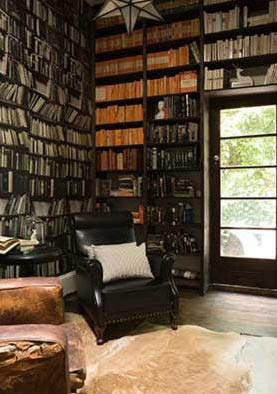 Is this not the perfect place for a Charlotte Mason Living Book addict like yours truly to spend a sybaritic weekend? Imagine curling up in that big leather chair with a hot chocolate and a packet of Lindt and just whiling the weekend away. I'd like that.
This seriously covetable library belongs to The White House Daylesford. You can win a weekend there simply by guessing the number of Penguin books there are on the bookshelves. Post your guestimate here on the Penguin Facebook page.
If I win, will somebody mind Jemimah? She's pretty good really - it's me that's been bad.
I'd be suffering total meltdown if it weren't Friday evening. The end is in sight. Shortly we'll be heading our for dinner at a local restaurant with our house guests and I can forget all about today. Which is good, because there is not much worth remembering.
Am I the only one who has days like this? How do you deal with them? Please share your secret coping weapons with me.
On another note, imagine spending a weekend here:
 Is this not the perfect place for a Charlotte Mason Living Book addict like yours truly to spend a sybaritic weekend? Imagine curling up in that big leather chair with a hot chocolate and a packet of Lindt and just whiling the weekend away. I'd like that.
This seriously covetable library belongs to The White House Daylesford. You can win a weekend there simply by guessing the number of Penguin books there are on the bookshelves. Post your guestimate here on the Penguin Facebook page.
If I win, will somebody mind Jemimah? She's pretty good really - it's me that's been bad.
The Life of Vivaldi by Jemimah

Vivaldi Caricature P.L.Ghezzi, Rome 1723
What is the name of the composer we have been studying this term? What can you tell me about his life?
Antonio Vivaldi.
He was once a priest and he was named The Red Priest because he had red hair. It was a normal thing for at least one of a poor man’s children to become a priest.
But one day Vivaldi became very sick and he could not work properly. Sometimes he had to leave in the middle of a service. People started to say to themselves, “What’s wrong with our new priest?” Finally they banned him from being a priest and said, “You are too sick to be a priest any longer for us.” He probably had asthma. Everyone said it was because he was born on the day of an earthquake.
Instead of being a priest, Vivaldi chose to be a composer and also he chose to teach children how to play his music. He worked in an orphanage in Venice where everything was covered in water. You had to have boats to get around. Wouldn’t that be funny! The orphanage was only for girls. In the girls’ orchestra they only played…everything! Vivaldi played the violin. You could not see the girls playing but they were there, coz otherwise how could the music be there? They were behind a curtain. The orphanage was called La Pieta. It looked more like a prison than a school. The girls were from all ages. They left when they were married. If they didn’t get married sometimes they never left.
Vivaldi wrote The Four Seasons and Gloria.
20 Aug 2009


19 Aug 2009
I ♥ Donna Hay

I signed up for Donna Hay's newsletter this afternoon. I figured a little gossip, some helpful kitchen advice and some free recipes would never go astray. Not in this house.
What I really wanted to do was visit her shop after viewing these beautiful photographs of it. Do take a look. Sadly, a trip to Sydney is not in the pipeline any time soon, so unless Donna opens a Melbourne store I'll have to content myself with her newsletter - and her magazine which my sister subscribes to on my behalf and which therefore magically appears in my letterbox on a regular basis.
I ♥ Donna's magazine. The woman is an exceptional food stylist, and the magazine's presentation has tempted me to try many a dish that otherwise would not have graced our table. I like the way she uses common sense too. Why, for example would you use homemade puff pastry to bake a pie? The stuff is nightmarishly difficult to make at home and is never cheap, not with all that butter between the layer upon layer. Donna tells you to go and buy some. I like that. She uses common ingredients too. Not verjuice and pheasant like some other Australian cook who will remain nameless, but is easy to find simply by putting these two words into google and pressing 'search'. (I would actually like her recipes too if it weren't for the above two criticisms of them.)
 My favourite Donna Hay magazines are the annual kids' issues. Jemimah cooked brownies from the current edition this afternoon. Most of the recipes in the kids' editions are suitable for my 7 year old to cook as part of our weekly kitchen garden lesson. Her styling might not be quite Donna's level every time, but sometimes she surprises me - like today.

 Absolutely nothing bad with the look - or taste of those brownies.
 Thanks Donna.
Thanks Jemimah.
The Seige of Calais
 The Siege of Calais, Versailles 1838 François-Edouard Picot
Tell the story of Edward III of Windsor and the Siege of Calais.
Edward III was very happy but he was not quite content with what he had. He wanted Calais. Calais was a town in France. Many people lived there so Edward guessed that he should not try and fight because they would be too strong and would fight him back and win. So he decided he would stop their food from being able to come so that they would starve to death and any that were left would give up and go to him and say that they were his. So he blocked off their food by making a camp around them. This way they could not get food and the people who imported food could not get in and give the people their food.
And so one by one people found that there was no food in their house. They said, “Only eat one meal in a day, then we will have more food.” But that didn’t work very well, and eventually they had no food at all and were forced to go to the King of England for help and to beg for mercy.
Some men were chosen to go and the way they did it was they announced in the market that there was an announcement and the Governor came out and said, “My dear friends, we have been forced to give up six men to give to the king. He has said we must.” Everyone started to cry. Then out of all the tears and worried people and sorrowful men there came two men. “I will go. It seems a pity to have to give up a whole town for just six men,” they said. Then came more and more, until finally there were six men ready to give themselves up for the rest of the town. So they chose to go.
Then the signal was sent that six men had been arranged. One of the knights came and took them and the Governor said, “Whatever he does with them, please try as hard as you can to stop the King from killing them.” The knight promised he would do his best in his power and then he set off with the men, ready to give themselves up. The King was pleased, but as soon as he had his power over them he said, “Executioner! Put them to death!” Everyone pleaded that he would not kill them but he ignored them as if they were mice. Finally the knight who had promised begged and begged but the king ignored him too. Eventually his wife the Queen fell down on her knees. She had never asked anything of him before but she felt it would be worth giving it a try. She said, “Please husband, save them. Save them all.” “My dear, I would do anything for you. Here, they are yours.” Then she gave them a good supper and sent them away to another country far away.
So Edward III became King of Calais.
Toad - a character analysis
 Toad's Last Little Song by Michael Hague 1980
 At last the hour for the banquet began to draw near, and Toad, who on leaving the others had retired to his bedroom, was still sitting there, melancholy and thoughtful. His brow resting on his paw, he pondered long and deeply. Gradually his countenance cleared, and he began to smile long, slow smiles. Then he took to giggling in a shy, self-conscious manner. At last he got up, locked the door, drew the curtains across the windows, collected all the chairs in the room and arranged them in a semicircle, and took up his position in front of them, swelling visibly. Then he bowed, coughed twice, and, letting himself go, with uplifted voice he sang, to the enraptured audience that his imagination so clearly saw.
TOAD'S LAST LITTLE SONG!
The Toad - came - home!
There was panic in the parlours and bowling in the halls,
There was crying in the cow-sheds and shrieking in the stalls,
When the Toad - came - home!
When the Toad - came - home!
There was smashing in of window and crashing in of door,
There was chivvying of weasels that fainted on the floor,
When the Toad - came - home!
Bang! go the drums!
The trumpeters are tooting and the soldiers are saluting,
And the cannon they are shooting and the motor-cars are hooting,
As the - Hero - comes!
Shout - Hoo-ray!
And let each one of the crowd try and shout it very loud,
In honour of an animal of whom you're justly proud,
For it's Toad's - great - day!
He sang this very loud, with great unction and expression; and when he had done, he sang it all over again.
Then he heaved a deep sigh; a long, long, long sigh.Kenneth Grahame The Wind in the Willows 1908
Which was your favourite character and why?
My favourite character was Toad because he was so foolish. He got mad when anything that he didn’t want happened and he thought he was the best and he was a bad friend, pretty much. He lied about being sorry and said “I will do better,” when really he was worse than when he began.
18 Aug 2009
The Bathers
 Sidney Nolan's The Bathers 1943 National Gallery of Victoria.
 Here's a narration from Jemimah's AO2 Term 2 examinations, which started today. (She's in Grade 1). She has been covering Australian artist, Sidney Nolan, for picture study, and was asked to describe her favourite picture. She chose 'Bathers' pictured above. She hasn't seen the picture since she studied it for two weeks several months ago. This is her answer:
Describe your favourite picture from this term's picture study and explain why you like it.
I like the swimming pool one.
I like it because there are lots of nice colours and the people in the background seem tiny when really they are big and the people that are close look too big.
There is a swimming pool and it has people beside it. Some are lying down enjoying themselves and sunbaking, but some people are swimming. There are red, blue and white flags in the distance and close up. There is a man who looks like he is naked! (That's a bit naughty. Perhaps you shouldn't put that.) There is a man in the background who is climbing up steps and it looks like he is climbing up to a lighthouse. There is a man in the water and it looks like one of his arms has been chopped off.
Do you know what I noticed? The water is a bright blue but normally water is a whitey colour. The ladies who are sunbaking are under an umbrella. One of the towels is red and white and the other one is blue and white. That's all.
Their last chance
 Hey, has anybody read Five Little Peppers And How They Grew by Margaret Stanley? Apparently it's an American classic.
We're ploughing through it as our family read-aloud at the moment, and when I say ploughing, I mean we're finding it really heavy going. Which is surprising rather, because it is one of the Ambleside Online Free Reads for Year 2 and generally I am totally cool with their choices. Not Five Little Peppers. I'm finding Margaret Stanley's writing style stilted and her grammar questionable at best. Take for example this sentence (if it actually constitutes a sentence...) which is found in the very first paragraph of the book:
All the "breathing spell" they could remember however, poor things; for times were always hard with them nowadays; and since the father died, when Phronsie was a baby, Mrs. Pepper had had hard work to scrape together money enough to put bread into her children's mouths, and to pay the rent of the little brown house.Doesn't make sense. Which is a bad way to start a book - in my humble opinion.
Then there is Miss Polly Perfect. Well, you know what I think about perfect children, and this one is sickeningly so...so far. (We're up to Chapter 6...of 25.)
So my question to those of you who know is:
Does it improve? Is it worth persevering? Do I keep on keeping on with Five Little Peppers? Are we going to love it and rate it as one of our all time favourites along with a generation or ten of American boys and girls?
If not, I'm going to ditch it and read Mistress Masham's Repose by T H White. Which is a classic as well. An English classic. A loved by me classic. And which isn't on the AO list. Which it should be, but it's not. So I'm going to have to fit it in somewhere, and right now as a substitute for Five Little Peppers is looking pretty attractive.
Oh, my version is not the beautiful Victorian version pictured above, which is a shame, because that cover alone would make me want to persevere. My version is the hardcover one in the Amazon link up above by Applewood books. It feels like a video cassette. Hard and shiny and new. I don't like it. The words are too small too. Doesn't help much.
So girls, the fate of the Pepper family is in your capable hands.
Yes or No?
Stay or Go?
You decide for me.
Please.
17 Aug 2009
Not supermums, just mums.
 It seems that I was the topic of much discussion at the communal dinner at the ski lodge last week. It went much like this, I understand:
 You wife works, keeps house AND homeschools Jemimah? She must be supermum! I could never do that...Hubby was forced to answer more questions on homeschooling from this room of strangers than he ever has before. Topics ranged from how and when and why, to (surprise surprise) socialisation and religion. It wasn't just for one night either. For almost the whole week homeschooling was discussed, analysed and dissected.
It was almost as if he and Jemimah were from another planet!
Why is this so? Why is it that homeschooling families are so stereotyped as hypereverything hippy weirdos instead of just parents who want to give our children the best education possible while wanting to be a part of their daily lives?
What we want for our children is surely not so very different from what all parents want for their children - is it? We all want the best for our kids. We all want them to be happy; we all want them to be successful; we all want them to achieve their goals. As Christians we may have specific desires for our daughter that non-Christians would not, but that would apply whether she were educated at home or at school.
I personally like spending time with my daughter. I like hanging out with her. I love learning with her too - and I learn new things every day. Surely this is fairly normal - don't most parents like spending time with their children?
I'm not saying here that homeschooling is for everyone. Clearly it is not, but any mother who really wants to school her kids can. They don't need to be university educated teachers; they don't need the patience of Job; they don't need perfect time-management or even perfectly behaved children. They don't need to be the beneficiary of a significant inheritance. They don't even need a denim jumper and Birkenstocks (although they would help). What they need to be is loving mothers who want to educate their kids at home. That's all. No more; no less.
Not supermums, just mums.
Oh and if you do want to be a homeschool supermum then this list is for you:
- Wear a denim jumper and Birkenstocks. Wear your hair long and parted down the centre. No fringe.
- Bake your own bread.
- Have perfect well mannered children - no ADHD or Aspergers, please. Especially no genetic abnormalities.
- Have highly intelligent children. Learning difficulties will not be tolerated.
- Have lots and lots of children. It is okay to adopt or foster, but they must be perfect and highly intelligent.
- Never, ever buy takeaway. Especially not McDonalds. Never even say the name McDonalds.
- Have a spotlessly maintained country styled home with pine furniture and floral fabrics. Squashy cushions are optional, but if you do choose to have them ensure that they're perfectly plumped at all times. And down filled. No synthetic batting please.
- Be happily married and take care that he is always fully employed. Always. Preferably as a pastor.
- Never be ill. Perfect children can't be ill but you shouldn't be either.
- Do not vaccinate your children.
- Be a craft whizz. Knitting, embroidery, crochet and scrapbooking are de rigeur and always sew your own denim jumpers. And knit your own socks.
- Speak many languages. One must be Latin.
- Never have a bad day. Never raise your voice in anger. Don't even get irritated.
- Don't have a television, and don't listen to modern music.
- Always achieve everything on your curriculum's list. Never leave out nature study, poetry or art. Ever.
- Smile and keep smiling!
You see, I'm not supermum. I'm not anywhere near it. If you are then I probably don't have much in common with you. I'm just a mum. An imperfect mum who happens to teach her imperfect daughter at home.
And I'm doing okay.
Not supermum, but I'm doing okay.
Some more favourite things...
 Frederick McCubbin's A bush burial 1890 The Geelong Gallery
A couple of links to my favourite things post:
Richele lists hers here, and you'll find Crissy's here, and Ruby's here.
Anybody else care to join in?
From their lists - some additional categories:
Favourite artist: Frederick McCubbin - his Bush Burial is my favourite painting.
Favourite number: Don't have one.
Favourite song: Only a Woman's Heart by Mary Black. It was playing when I first met my husband...
Favourite singer: Kitaro
Favourite hobby: Travelling!
Favourite verse of Scripture: I don't have a favourite verse, believing instead that all Scripture is give by God to equip his Church, and that each day there will be a new and exciting message for me. That said, I am continually thankful for this one:
For it is by grace you have been saved, through faith - and this not from yourselves, it is the gift of God - not by works, so that no one can boast. Ephesians 2:8-9 NIV
15 Aug 2009
One more sleep
...and they'll be home again.
With me.
Where they belong.
So here's Mem Fox reading - well singing - her new book, 10 Little Fingers and 10 Little Toes. If you play it to your kiddywinks tonight, you can do so knowing that Jemimah and her Daddy will be home really soon.
Thanks for putting up with my totally self-centred frivolous posts this last ten days.
I'll be back to my serious and sensible homschooling posts very soon.
I just hope that I'm in time.
With me.
Where they belong.
So here's Mem Fox reading - well singing - her new book, 10 Little Fingers and 10 Little Toes. If you play it to your kiddywinks tonight, you can do so knowing that Jemimah and her Daddy will be home really soon.
Thanks for putting up with my totally self-centred frivolous posts this last ten days.
I'll be back to my serious and sensible homschooling posts very soon.
I just hope that I'm in time.
14 Aug 2009
A few of my favourite things
 Richele asked me my favourite colour.
If you ask Jemimah, she'll say it's red. She's right - I do like red; but it's not my favourite. My favourite is the colour that a muddy puddle goes when algae start to grow in it. It's sort of a muddy greeny brownish colour.
Now, with the help of the Fellisimo palate, it actually has a name: Guiseppe. My favourite colour is Guiseppe with a good dollop of mud added to make it less clear and more complex. It's sort of the colour of walls in the tea ceremony room of the wonderful Tempura Endo Yasaka Restaurant in the photo above. Sort of. My favourite has more green than that.
Can you see why I tell Jemimah that it is red? Can you imagine me telling my seven year old:
Now, with the help of the Fellisimo palate, it actually has a name: Guiseppe. My favourite colour is Guiseppe with a good dollop of mud added to make it less clear and more complex. It's sort of the colour of walls in the tea ceremony room of the wonderful Tempura Endo Yasaka Restaurant in the photo above. Sort of. My favourite has more green than that.
Can you see why I tell Jemimah that it is red? Can you imagine me telling my seven year old:
My favourite colour is Guiseppe, dear. Sort of.
I don't think so!!!
So I say it's red. Easy.
Which makes my wonder what your favourite colour is - now that you have a name to describe it. Do let me know.
Here are some more of my favourites:
Favourite colour: Red - the colour of the sole of a Christian Louboutin heel.
Favourite thing to touch: The nape of Jemimah's neck.
Favourite smell: Japanese incense, jinko koboku.
Favourite sound: Waves on the beach.
Favourite sound: Waves on the beach.
Favourite taste: Fresh raspberries with vanilla icecream or Godiva Truffe Grand Marnier. I can't decide.
Favourite animal: Audrey my toy poodle.
Favourite book as a child: The Sailor Dog by Margaret Wise Brown
Fvourite book as an adult: Memoirs of a Geisha by Arthur Golden
Favourite place: My sitting room at home.
Favourite country: Japan
Favourite city: Melbourne.
Favourite flower: Lily of the Valley
Favourite Material Possession: A pendant designed for me by Jemimah and her Daddy and made using a piece of jade from hubby's grandmother.
Do let me know a few of your favourite things.
Please.
I would like to know. Truly.
Do let me know a few of your favourite things.
Please.
I would like to know. Truly.
See what you've started, Richele?
Subscribe to:
Posts (Atom)